


A Planet of Grand Proportions
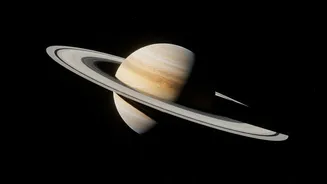
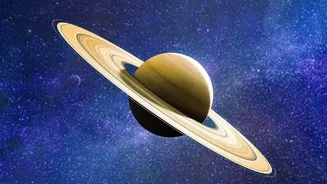
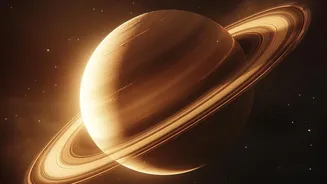
Saturn, the sixth planet from our Sun, is a world of superlatives. It is a gas giant, a colossal ball of hydrogen and helium so large that over 760 Earths could fit inside it. But its most defining feature is its breathtaking system of rings, composed
of countless particles of ice and rock. While beautiful, these rings are not just for show. They play a crucial role in the planet's climate. Saturn takes about 29.5 Earth years to complete one orbit around the Sun, meaning each of its four seasons is a multi-year affair. Scientists have long been fascinated by how these long, drawn-out seasons affect its turbulent atmosphere. Recent observations are providing new and surprising answers.
Hubble's Long Watch
The Hubble Space Telescope has been observing Saturn for decades, creating a long-term record of its atmospheric changes. As part of the Outer Planet Atmospheres Legacy (OPAL) program, Hubble monitors the outer planets annually, allowing scientists to track weather patterns, storms, and seasonal changes over time. These consistent, year-over-year observations are vital for understanding a planet where changes unfold over years, not months. By capturing images in different wavelengths of light, including visible and ultraviolet, Hubble can see changes in the colour and height of clouds, revealing a dynamic and ever-shifting world. One recent study compiled data from 2018 to 2020, just after the planet's northern hemisphere experienced its summer solstice, providing a key snapshot of seasonal transition.
Shadows and Shifting Winds
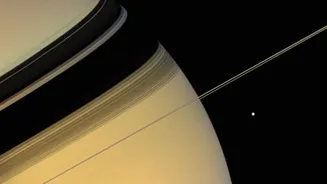
One of the most fascinating discoveries involves the interplay between the rings and the atmosphere. The dense rings cast vast shadows over the planet, blocking sunlight from reaching certain regions. This 'ring shadow' has a profound effect, especially during winter in a given hemisphere, making it even colder than it would be from seasonal change alone. This lack of sunlight changes the chemistry and temperature of the upper atmosphere. Hubble's data, combined with earlier findings from the Cassini mission, has revealed surprising year-to-year shifts. For instance, Saturn’s equator brightened by 5 to 10 percent between 2018 and 2020. Wind speeds also showed variability, with equatorial winds measured at around 1,600 kilometres per hour in 2018 before decreasing back to the 1,300 km/h speeds recorded years earlier by Cassini. Scientists believe these wind speed changes might indicate that the clouds in 2018 were about 60 kilometres deeper than at other times.
The Curious Case of 'Ring Rain'
Beyond casting shadows, the rings actively 'rain' down on the planet. This isn't rain in the earthly sense, but a shower of icy particles pulled from the rings into Saturn's upper atmosphere by the planet's magnetic field. This phenomenon, dubbed 'ring rain', was first theorised based on data from the Voyager probes in the 1980s but has been explored in much greater detail using a combination of data from Hubble, Cassini, and other missions. This influx of water-based particles has a major impact, 'quenching' the ionosphere by reducing the density of charged particles and changing its chemical composition and temperature. This interaction is so significant that it leaves dark, shadow-like bands in the planet's otherwise uniform infrared glow, covering up to 43 percent of the upper atmosphere at certain latitudes.
A Glimpse into Other Worlds
Studying Saturn’s complex climate system does more than just teach us about our own cosmic neighbour. It serves as a natural laboratory for understanding the atmospheres of gas giants throughout the universe. By observing how Saturn's atmosphere responds to its long seasons, powerful winds, and the unique influence of its rings, scientists can build better models for how similar planets—including the many exoplanets discovered orbiting other stars—might behave. The collaboration between Hubble and the newer James Webb Space Telescope (JWST), which observes in infrared light, is providing an even more comprehensive, three-dimensional view of Saturn’s weather. This combined effort allows scientists to probe different atmospheric depths, tracking storms and chemical changes with unprecedented clarity.