





A Day Longer Than a Year?
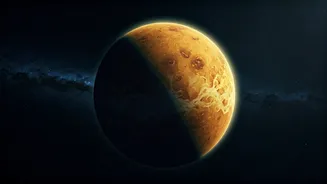
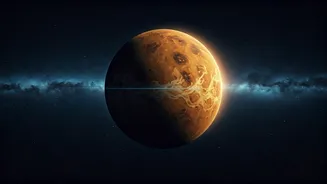
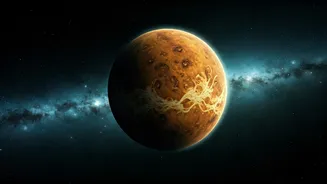
It sounds like a riddle, but it’s a matter of simple, albeit strange, celestial mechanics. A planet has two key time cycles: its orbital period (a 'year') and its rotational period (a 'day'). For Venus, it takes about 225 Earth days to complete one full
orbit around the Sun. That’s its year. However, it takes the planet a whopping 243 Earth days to rotate just once on its axis. This means that if you were standing on the surface of Venus, a single day would drag on for longer than the time it takes the entire planet to travel around the Sun. By the time the sun 'rises' and 'sets' once, Venus has already completed another lap in its cosmic race. It’s a concept that completely flips our Earth-based understanding of time.
How We Know for Sure
For decades, scientists had estimates for Venus's rotation, but pinning down the exact number was notoriously difficult due to its impenetrable cloud cover. Recently, however, researchers used a powerful technique to get the most precise measurement ever. A team of scientists used the Goldstone Solar System Radar in California to bounce radio waves off Venus's surface over a period of 15 years. By precisely timing how long it took for the radar echo to return, and analysing the subtle shifts in the signal, they could measure the planet's spin rate with unprecedented accuracy. They essentially used radio signals as a high-tech stopwatch, timing the planet’s sluggish rotation down to the millisecond. This long-term study confirmed the day-year discrepancy and also revealed that the rotation speed isn't perfectly constant; it seems to vary slightly.
The Culprit: A Crushing Atmosphere
So, why does Venus spin so slowly? The primary suspect is its ridiculously thick and heavy atmosphere. The Venusian atmosphere is more than 90 times denser than Earth's, creating a surface pressure equivalent to being a kilometre deep in our ocean. This colossal blanket of gas is in a state of 'super-rotation', whipping around the planet at speeds up to 60 times faster than the planet itself spins. Scientists believe this fast-moving, heavy atmosphere acts like a brake, exerting immense friction and drag on the rocky surface below. Over billions of years, this constant atmospheric drag has likely slowed Venus's rotation to its current, leisurely pace. It’s as if the planet is constantly fighting against its own weather.
Even Weirder: It Spins Backwards
As if a day longer than a year wasn’t strange enough, Venus also has a 'retrograde' rotation. While most planets in our solar system, including Earth, spin counter-clockwise on their axis, Venus spins clockwise. From the perspective of its surface, the Sun would appear to rise in the west and set in the east. Scientists aren’t entirely sure why. The leading theory is that early in its history, Venus was struck by a massive planet-sized object that was large enough to not only shatter it, but to completely reverse its direction of spin. Another theory suggests that the gravitational pull of its thick atmosphere, combined with tidal forces from the Sun, could have gradually 'flipped' the planet over.
Why This Bizarre Planet Matters
Studying Venus's weird rotation isn’t just cosmic trivia. The precise measurements from the radar studies allowed scientists to learn more about the planet’s interior. Just as a spinning top wobbles, Venus has a slight wobble, or 'precession', on its axis. By measuring this tiny wobble, the research team was able to calculate the size of Venus’s core for the first time. They determined it has a core roughly 7,000 kilometres in diameter, similar in size to Earth's. However, they couldn't yet confirm if it is liquid or solid. Understanding the core of Venus is crucial to understanding why Earth’s twin went down such a different evolutionary path, turning into a hothouse inferno while Earth became a haven for life. Each strange fact we uncover is another clue in solving the mystery of planetary evolution.