






Create Your Urban Observatory
First, take control of your immediate environment. The biggest challenge in a city is ambient light. Turn off all the lights on your balcony and, if possible, in the room connected to it. Even closing the curtains behind you can make a significant difference.
Give your eyes time to adjust to the darkness; this can take 20 to 30 minutes, so be patient. This process, called dark adaptation, dramatically increases your ability to see fainter stars. Also, get comfortable. A reclining chair is ideal as it prevents neck strain. Bring out a flask of warm tea or coffee, as the October nights can get a little crisp. The goal is to create a small pocket of darkness and comfort from which you can patiently observe the sky.
Gear Up: Apps Are Your Best Friend
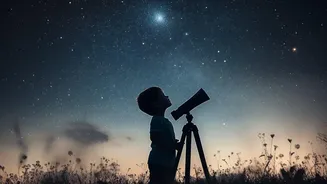
You don't need an expensive telescope. In fact, your smartphone is the most powerful tool for an urban stargazer. Download a stargazing app like Sky Tonight, Star Walk, or Stellarium. These apps use your phone's GPS and compass to show you a real-time map of the sky. Point your phone at a bright object, and the app will identify it for you, whether it's a planet, a star, or a satellite. This is invaluable for navigating the urban sky, where only the brightest objects are visible. If you have a pair of binoculars, they can enhance the view of many objects, especially planets and the Moon, but they aren't essential to get started. The most important thing is to know what you're looking for, and an app is the perfect guide.
The Main Event: Saturn at Opposition
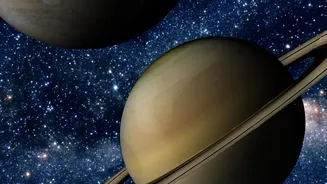
October 2026 is a fantastic month for planet-watchers, thanks to Saturn. On October 4th, Saturn is at opposition, meaning Earth is directly between Saturn and the Sun. This makes it the biggest and brightest it will appear all year, visible for the entire night. For observers in India, Saturn will rise in the east around sunset (approximately 6:11 PM), reach its highest point around midnight, and set in the west around sunrise. It will be easily visible to the naked eye as a bright, steady, yellowish point of light. You won't be able to see the rings without a telescope, but knowing you're looking at the iconic ringed planet from your own balcony is a thrill in itself. The nights immediately surrounding October 4th are also excellent for viewing.
Catch a Shooting Star: Two Meteor Showers
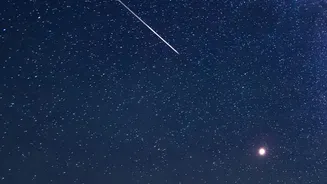
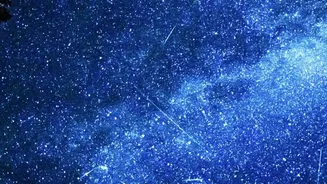
October features two meteor showers. First are the Draconids, peaking on the night of October 8-9. This is an unusual shower, best viewed in the early evening, just after full darkness sets in. While typically modest with about 5-10 meteors per hour, the great news for 2026 is that the peak occurs near the new moon, meaning darker skies and better viewing conditions. Later in the month, look for the Orionids, which peak on the night of October 21-22. These are fast, bright meteors created by debris from Halley's Comet. The best time to watch is in the pre-dawn hours of October 22nd. A bright moon will set after midnight, providing a window of darkness for the show. For both showers, find the darkest spot you can, lie back, and look up.
Find Your Bearings With Bright Constellations
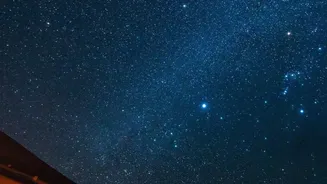
Even in light-polluted skies, you can trace out the brightest constellations. This October, look for the 'Great Square' of Pegasus, an easy-to-spot large square of four bright stars that will be high in the evening sky. You can also spot Cassiopeia, which looks like a bright 'W' or 'M' in the northern sky. Learning to identify these patterns provides a basic map of the night. Using your stargazing app, you can use these bright anchor points to find other, fainter objects. While you might not see the faint dust lanes of the Milky Way from a city balcony, you can certainly connect with the grand architecture of the cosmos, one constellation at a time.