






The Sun’s Dynamic Magnetic Field
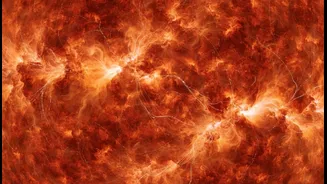
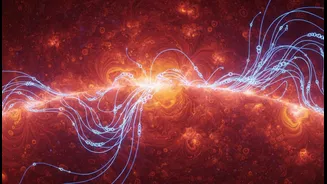
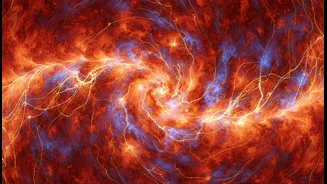
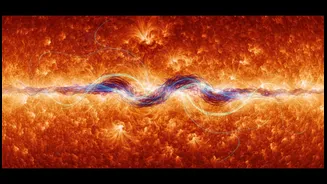
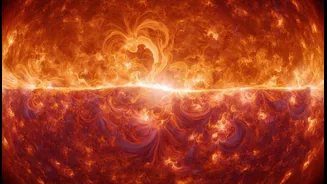
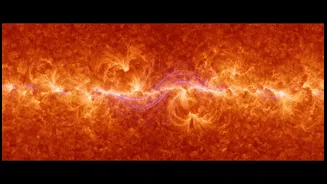
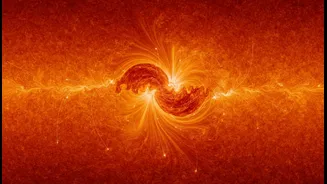
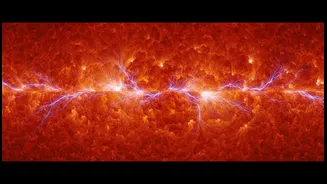
The Sun isn't just a hot ball of gas; it's a magnetic powerhouse. This magnetic field is not static. Instead, it goes through an 11-year cycle of activity, growing in strength and complexity before flipping its north and south poles. This cycle drives
much of the Sun's behavior, from the dark sunspots that pepper its surface to the violent eruptions known as solar flares and coronal mass ejections (CMEs). These events are not just cosmic light shows; they create space weather that can have real-world consequences on Earth. A powerful solar storm can disrupt our satellites, endanger astronauts, and even knock out power grids. Understanding the engine behind this magnetic field is crucial to predicting its behavior and protecting our technology-dependent society.
A Journey into the Solar Interior
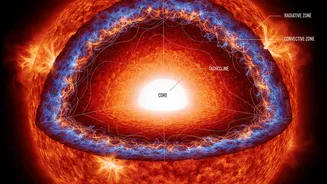
To find the source of this magnetic activity, we have to travel deep inside the Sun, a place we can only probe indirectly using a science called helioseismology. The solar interior has distinct layers. At the very center is the core, where nuclear fusion generates immense energy. This energy travels outward through the vast radiative zone, which rotates like a solid, unified ball. The outermost 30% of the Sun's interior is the convection zone, a turbulent region of boiling plasma that churns like a pot of water. Here, different parts rotate at different speeds—the equator spins faster than the poles. For a long time, the crucial question was how these two very different zones—the rigid radiative zone and the fluid convection zone—interact.
The Tachocline: A 'Shear' Genius
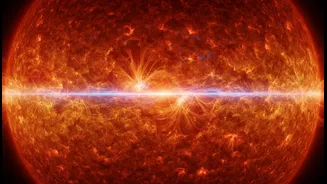
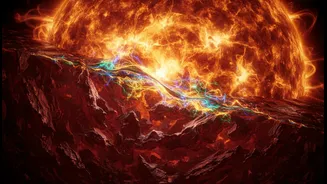
The answer lies in a surprisingly thin boundary layer sandwiched between the two: the tachocline. First theorized in 1992, the tachocline is only about 4% of the Sun's radius thick, yet it's a place of extreme physics. It marks the abrupt transition where the solid-body rotation of the radiative zone meets the differential rotation of the convection zone. Imagine two giant gears turning at different speeds, grinding against each other. This creates an enormous amount of shear—a stretching and twisting force. Scientists now believe this intense shear is the key ingredient for the solar dynamo, the process that generates the magnetic field.
How the Tachocline Forges Magnetic Fields
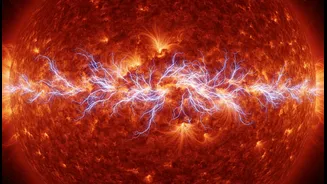
The leading theory is that the tachocline acts as a magnetic amplifier. The process, known as the solar dynamo, converts the kinetic energy of the Sun's motion into magnetic energy. The idea is that weak magnetic fields get pulled into the tachocline. The intense shear in this layer grabs the magnetic field lines, stretching and winding them around the Sun like a ball of yarn, dramatically increasing their strength. The tachocline is believed to store and organize this powerful magnetic field. Eventually, parts of this intensified magnetic field become buoyant, rising through the convection zone to erupt on the surface as sunspots and other signs of solar activity.
Solving a Decades-Old Solar Puzzle
Recent studies and advanced computer simulations are providing stronger evidence for the tachocline's central role. Researchers have observed patterns of plasma flow deep within the Sun that start near the tachocline and migrate towards the surface over several years, matching the pattern of sunspots that appear later. These findings strongly support the idea that the solar dynamo has a deep-seated origin in the tachocline, rather than being a shallow process near the surface. By better understanding how this layer works, scientists can create more accurate models of the solar cycle. This could one day lead to better forecasts of space weather, giving us advance warning of potentially disruptive solar storms.