




What Are These Little Red Dots?
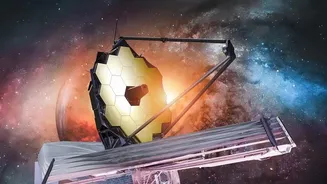
Since it began operations, the James Webb Space Telescope has been peering into the cosmic dawn, the period just a few hundred million years after the Big Bang. In these incredible images, astronomers started noticing a population of objects they nicknamed
'Little Red Dots'. These are extremely compact and, as the name suggests, distinctly red. But their simple appearance is deceptive. Each dot is a powerhouse of activity from over 13 billion years ago. The central mystery that scientists are racing to solve is what they are. Early theories proposed they were young galaxies forming stars at a furious and unexpected pace. More recent studies, however, suggest a more dramatic origin: they could be the glowing, dust-enshrouded cocoons hiding supermassive black holes, feeding and growing at a phenomenal rate. The debate itself shows how these dots are pushing the boundaries of our knowledge.
A Cosmic Time Machine
The reason these dots are so important is because looking at them is the same as looking back in time. Light, while incredibly fast, travels at a finite speed. The light from these ancient objects has been traveling for billions of years to reach Webb's mirrors. So, when we see a galaxy that is 13 billion light-years away, we are seeing it as it was 13 billion years ago. This turns the telescope into a time machine. The red colour is a direct result of this immense journey. As the universe has expanded over billions of years, it has stretched the fabric of space itself. The light traveling through that space gets stretched along with it, a phenomenon called 'cosmological redshift'. Ultraviolet and visible light from a young galaxy gets stretched into longer, redder wavelengths, eventually shifting into the infrared spectrum. This is why Webb, with its powerful infrared vision, is the perfect tool for the job.
Rewriting the Cosmic History Books
Before Webb, our models of the early universe suggested a much slower, more gradual build-up. The first stars and galaxies were thought to be small and simple, taking billions of years to evolve into the grand structures we see today. The Little Red Dots are challenging this entire timeline. Whether they are star-forming galaxies or nascent black holes, they are far more massive, bright, and complex than theories predicted for that early epoch. It’s the cosmic equivalent of finding a fully-grown adult in a nursery. Astronomers have already confirmed galaxies like JADES-GS-z14-0, which existed less than 300 million years after the Big Bang—a mere 2% of the universe's current age. Discoveries like these are forcing scientists back to the drawing board to figure out how cosmic structures could form so big, so fast.
The Hunt for Answers
Determining the true nature of these objects is now a major focus of astronomy. Scientists are using Webb’s spectrographs to break down the light from each dot into its chemical fingerprints. These spectra can reveal whether the light is coming from a massive population of young stars or from gas being heated to extreme temperatures as it swirls into a black hole. Some of the latest research proposes a fascinating hybrid idea: that some of these Little Red Dots are actually the extremely bright centres of much larger galaxies. The host galaxy itself might be too faint and diffuse to be seen across such a vast cosmic distance, leaving only its brilliant, compact core visible to us. This would mean the early universe was not just forming dots, but was already building large, structured galaxies we simply couldn't see before.