





The Time Machine Above Your Head
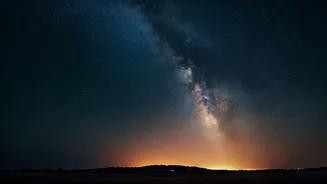
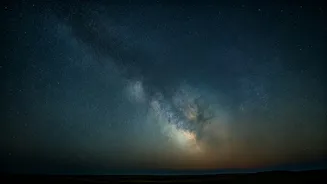
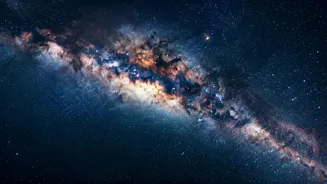
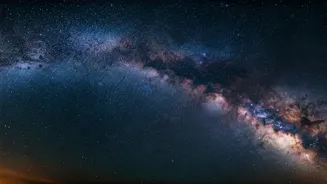
We often talk about wanting a time machine, but we have one right above us every clear night. The universe is so vast that even light, the fastest thing we know, takes time to travel. When we look at a star, we are not seeing it as it is right now. We are seeing it as it was
in the past. The unit for this cosmic distance is the light-year, which is the distance light travels in one year—a staggering 9.5 trillion kilometres. So, if a star is 100 light-years away, the light hitting your eyes tonight left that star 100 years ago. You are literally looking at a snapshot of history.
Meeting Your Ancient Visitors
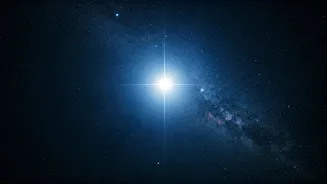
Many of the stars easily visible from India are broadcasting their ancient light. Consider the constellation of Orion, the Hunter (Kalpurush), a familiar sight in our winter skies. The bright, reddish star Betelgeuse, which forms Orion's shoulder, is over 600 light-years away. The light you see from it tonight started its journey around the 1400s, while the Lodhi dynasty ruled parts of North India. The brilliant blue-white star Rigel, Orion's foot, is even further, at about 860 light-years. Its light began travelling towards us when the Pala Empire was a dominant force in the subcontinent. Every star tells a different story from a different era. The Pole Star, or Dhruva Tara, a guide for travellers for millennia, is about 433 light-years away. Its light set off during the height of the Mughal Empire.
The Incredible Journey of a Photon
The headline's mention of light travelling 'safely' is a poetic way to capture an incredible feat of cosmic endurance. A single photon—a particle of light—travels from its star's core and embarks on a solitary journey across the vacuum of space. For centuries, it hurtles through the void, navigating past vast clouds of cosmic dust, swerving around the immense gravitational pull of other celestial bodies, and surviving the seemingly empty but hazardous expanse between solar systems. The vast majority of photons emitted by a star fly off into empty space, never to be seen. The few that end their epic journey by landing on your retina, delivering their ancient message directly to you, have completed a truly remarkable voyage.
A Shared Sky, Through Generations
This cosmic spectacle connects us not just to the distant past of the universe, but to our own history. The same stars you see from your balcony in Mumbai or your village in Kerala were gazed upon by your grandparents, and their grandparents before them. Ancient Indian astronomers like Aryabhata charted their movements. Emperors and poets wrote about them. They are a constant, unchanging backdrop to the entire story of human civilization on this land. Looking up at the stars is a shared human experience that transcends time, culture, and geography. It is a reminder that while our lives are fleeting, we are part of a much grander, more ancient story.
How to Best Welcome the Starlight
To truly appreciate this celestial show, you don't need an expensive telescope. The most important thing is to find a spot with as little light pollution as possible. If you're in a city, even a park, a quiet rooftop, or a less-lit street can make a difference. Give your eyes at least 15-20 minutes to adjust to the darkness; you'll be amazed at how many more stars become visible. You can use a simple stargazing app on your phone (use the red-light mode to preserve your night vision) to identify constellations and stars. But more importantly, just allow yourself the time to look up and wonder. Think about the incredible journey that light has taken to reach you, and feel the connection to the universe it brings.