




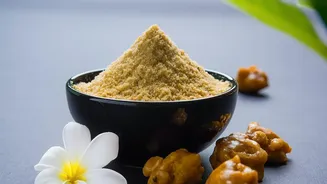

The Calorie and Sugar Content
At first glance, the nutritional labels for jaggery and white sugar look remarkably similar. A 100-gram serving of jaggery contains around 383 calories, while the same amount of white sugar has about 387 calories. This marginal difference means that swapping
sugar for jaggery will not impact your calorie intake in any meaningful way. Both are, first and foremost, concentrated sources of sugar. White sugar is nearly 100% sucrose. Jaggery is also predominantly sugar, typically composed of 65-85% sucrose and another 10-15% of other simple sugars like glucose and fructose. The idea that jaggery is somehow 'less' sugar is a common myth; by law in India, it must be at least 90% total sugars by dry weight.
The Nutrient Advantage of Jaggery
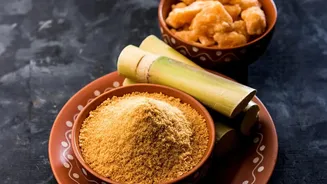
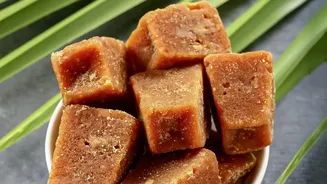
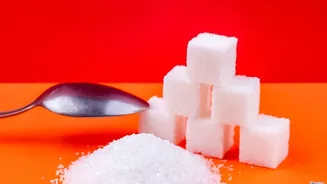
The primary difference lies in the processing. White sugar is refined to the point where only pure sucrose remains, stripping it of all other nutrients. Jaggery, being unrefined, retains some of the molasses from the sugarcane juice. This means it contains trace amounts of essential minerals that sugar lacks. Jaggery is a source of iron, potassium, magnesium, and calcium. For instance, 100 grams of jaggery can provide a significant portion of your daily iron needs. It also contains antioxidants and small amounts of B vitamins. This is where jaggery earns its reputation as 'healthier'—it’s not empty calories like white sugar.
The Reality of Portion Sizes
While the mineral content in 100 grams of jaggery is impressive, it's crucial to consider realistic serving sizes. Most people don't consume 100 grams of any sweetener in one go. A typical serving might be one or two teaspoons (about 10-15 grams). At this amount, the contribution of minerals is quite small, providing only a tiny fraction of your recommended daily intake. To get a substantial mineral boost from jaggery, you would have to consume a very large quantity, and the negative effects of the high sugar intake would far outweigh the benefits of the minerals. Therefore, while jaggery is nutritionally superior gram for gram, the difference is almost negligible in the amounts typically eaten.
Impact on Blood Sugar
A common belief is that jaggery is safer for people with diabetes because it is 'natural'. This is a dangerous misconception. The glycemic index (GI), which measures how quickly a food raises blood sugar, tells a surprising story. White sugar has a GI of around 65. Several studies and analyses have found that sugarcane jaggery has a GI that is actually higher, often cited as around 84. This means jaggery can cause a faster and sharper spike in blood sugar than white sugar. For anyone managing blood sugar levels, including those with diabetes or insulin resistance, neither jaggery nor sugar is a 'safe' option and both should be consumed with extreme caution and moderation.
The Verdict: Better, Not a Health Food
So, should you throw out your jaggery? Not necessarily. Its unrefined nature means it's free from the chemicals used in sugar processing and does offer a small nutrient package that sugar doesn't. Many also prefer its rich, molasses-like flavour in traditional Indian sweets and drinks. The key is to change your mindset. Jaggery is not a health food or a weight-loss aid. It is simply a marginally 'less bad' version of sugar. Think of it as a slightly better choice when a sweetener is needed, rather than a healthy ingredient you can add freely to your diet. The age-old wisdom of moderation is what truly matters.