





The New Fuel: Petabytes of Data
India's space program is generating data on an unprecedented scale. Every satellite, from remote sensing to communication and navigation, beams back a torrent of information. The Indian Space Research Organisation (ISRO) and a growing number of private
firms are now dealing with vast data archives that are impossible to manage with human analysis alone. This is where AI and data science come in. Instead of just launching hardware, the focus is shifting to what we do with the information it collects. AI algorithms are crucial for sifting through this data, identifying patterns, discarding redundant information, and turning raw numbers into actionable intelligence. This marks a fundamental change, moving the industry from being builders of spacecraft to interpreters of the cosmos.
Smarter Satellites, Faster Insights
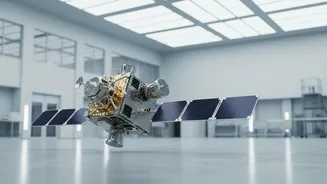
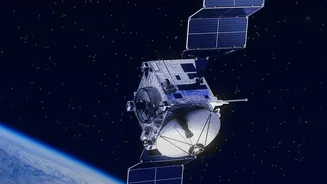
A major evolution is happening in orbit: satellites are becoming intelligent. Indian space-tech startups are pioneering 'edge AI,' integrating AI processing directly onto satellites. This allows data to be analysed in space, so only crucial insights are sent back to Earth. This solves a huge bottleneck, reducing the time between data capture and decision-making for critical applications like disaster management, defence, and climate monitoring. Private companies like Pixxel and Sarvam AI are collaborating on an AI-powered orbital data centre, aiming to run complex AI models directly in space. This move towards on-board processing will enable real-time analysis of everything from crop health to urban infrastructure changes.
AI in Mission Control and Operations
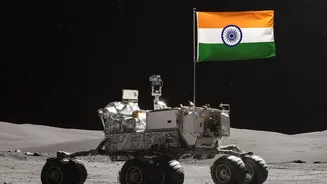
Beyond data analysis, AI is becoming integral to the success and safety of space missions themselves. For ISRO's landmark missions like Chandrayaan-3, AI-powered sensors and algorithms were vital. The lander used AI to analyse the lunar surface in real-time, detecting hazards like craters and boulders to ensure a safe, soft landing. AI is also used for monitoring the health of spacecraft, predicting equipment failures, and recommending adjustments to prolong mission life. This technology is also critical for autonomous navigation, especially for deep-space missions where communication delays with Earth are significant. For the upcoming Gaganyaan human spaceflight mission, AI systems are being integrated to handle emergencies and support the crew escape system, enhancing astronaut safety.
A Booming Private Sector and New Jobs
The opening of India's space sector has created a vibrant ecosystem of private companies, many of which are built on data and AI. The government's IN-SPACe initiative acts as a facilitator, authorising and supporting these non-government entities. Startups like SatSure Analytics are developing large-scale AI models to process Earth observation data for sectors like agriculture and finance. Others, like Digantara and Dhruva Space, are focused on everything from AI-based space traffic management to building the smart satellites themselves. This has created a surge in demand for professionals with skills in Python, C++, machine learning, big data analytics, and cloud computing. Roles like Data Scientist, AI/ML Engineer, and Satellite Systems Engineer are becoming as crucial as traditional aerospace engineering.