





For decades, one of the biggest questions in science has been: what is dark matter? This mysterious, invisible substance makes up about 85% of all matter in the universe, yet we can't see it. One elegant theory proposed an answer: ancient black holes.
The Universe’s Invisible Glue
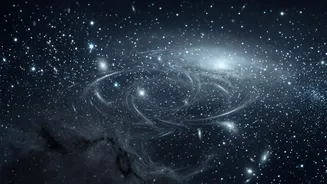
First, let's recap the mystery. When astronomers look at galaxies, they see that stars on the outer edges are moving so fast they should fly off into space. The gravity from all the visible matter—stars, gas, and dust—isn't strong enough to hold them in orbit. This suggests there's an enormous amount of unseen mass providing the extra gravitational pull needed to keep galaxies together. Scientists call this invisible stuff 'dark matter'. According to our best estimates, it outweighs all the ordinary matter we can see and interact with by a factor of more than five to one. Despite its abundance, dark matter doesn’t seem to interact with light or any other form of electromagnetic radiation, which is why we can't observe it directly. Finding out what it’s made of is one of the ultimate goals of modern physics.
A Candidate from the Dawn of Time
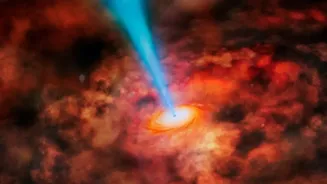
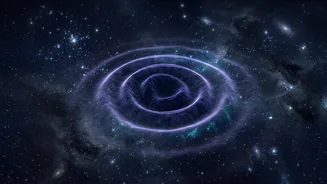
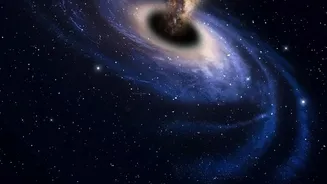
For a while, a fascinating candidate gained traction: Primordial Black Holes (PBHs). Unlike the black holes we know that form from the collapse of giant stars, PBHs are theoretical objects believed to have formed from dense pockets of matter in the chaotic, super-hot moments right after the Big Bang. This made them a perfect candidate for dark matter. They would be massive, they wouldn't emit light, and they would have been spread throughout the early universe, providing the gravitational scaffolding for galaxies to form. The idea was elegant because it didn’t require inventing new, undiscovered particles; it used a known (though still theoretical) type of object to solve the puzzle. The detection of gravitational waves from merging black holes by experiments like LIGO and Virgo, some with surprisingly large masses, added to the intrigue, as these masses were consistent with some PBH models.
The Evidence Mounts Against
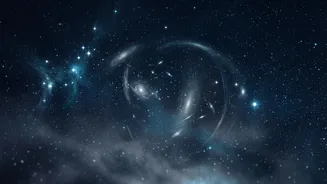
However, the case for PBHs as the main source of dark matter has started to crumble under the weight of new evidence. A key method for hunting these objects is gravitational microlensing. If a PBH passes in front of a distant star, its gravity should bend the starlight, causing the star to briefly brighten. If dark matter were made of PBHs, we should be seeing these microlensing events all the time. But extensive surveys, like the Optical Gravitational Lensing Experiment (OGLE), have scanned the skies for years and found far fewer of these events than the PBH theory would predict. One recent analysis concluded that the observed events can be explained by known stars and that PBHs cannot be a significant fraction of dark matter.
Observational Constraints Tighten
It's not just microlensing that casts doubt on the theory. Other observations have also placed tight constraints on how many PBHs of different sizes could possibly exist. For instance, the stability of white dwarfs and neutron stars in dense star clusters rules out large populations of PBHs in certain mass ranges; if they were present, they would be captured by these stars and destroy them from the inside, which is not something we observe. Furthermore, if PBHs were accreting gas in the galactic centre, they should be emitting X-rays, but observatories like NuSTAR haven't seen the expected signals. While some researchers argue these constraints depend on specific assumptions, the cumulative effect of these non-detections across multiple lines of inquiry has made the PBH hypothesis much less likely.
Back to the Particle Hunt
With primordial black holes looking less probable, the focus is shifting back to the other main class of candidates: new, undiscovered subatomic particles. The leading contenders have long been WIMPs (Weakly Interacting Massive Particles), which are heavy, slow_moving particles that would interact only through gravity and the weak nuclear force. Another promising candidate is the axion, a much lighter, hypothetical particle proposed to solve a different problem in particle physics. While decades of searching for these particles have so far come up empty, new experiments and observations are offering fresh hope. Recent findings from the Large Hadron Collider, for example, have detected an extremely rare decay of a 'beauty quark', opening a new window to probe for unknown particles that might be linked to dark matter.