




The Allure of the Telescope
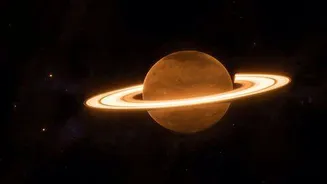
Let's be honest: when you picture yourself as an astronomer, you’re probably standing next to a telescope, peering into an eyepiece to see Saturn's rings or the swirling bands of Jupiter. Telescopes promise a portal to other worlds, and the impulse to buy
one as your first piece of equipment is completely understandable. They represent the most direct way to get those jaw-dropping, high-magnification views we see in magazines. But this powerful allure can sometimes lead new stargazers down a path of frustration. The jump from casual curiosity to operating a complex piece of astronomical equipment is often steeper than most people realize.
The Binocular Advantage: A Wider World
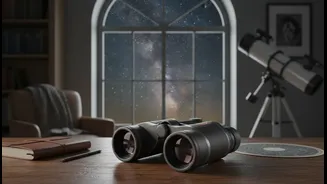
The single greatest advantage binoculars have for a beginner is their wide field of view. While a telescope zooms in on a tiny patch of the sky, binoculars show you a large, expansive vista. This is crucial when you're just starting out. Instead of a frustrating search for an invisible target, binoculars allow you to see entire constellations in context. You can easily spot how star patterns connect and where objects are in relation to one another. Seeing the Andromeda Galaxy or the Pleiades star cluster nestled within their starry surroundings is a breathtaking experience that many telescopes, with their narrow views, simply cannot provide.
Learning the Celestial Map
Before you can find faint galaxies, you need to know how to navigate the night sky. Binoculars are the ultimate learning tool for this. The view they provide is intuitive—it's upright and correct, matching what you see on a star chart or a smartphone app. This makes the process of 'star-hopping'—using bright, known stars as guideposts to find fainter objects—simple and rewarding. Many beginner telescopes produce an image that is upside-down or mirrored, which can be incredibly confusing when you're trying to match what you see in the eyepiece to the sky above you. With binoculars, you learn the actual layout of the cosmos, a fundamental skill for any astronomer.
Instant Gratification and Portability
One of the biggest hurdles in any new hobby is the 'friction' to get started. A telescope often involves assembly, alignment, and a significant setup time. Binoculars have zero setup. You just grab them, step outside, and look up. This spontaneity means you're more likely to use them on a clear night, even if you only have 15 minutes. They are also incredibly portable, easily fitting into a backpack for a camping trip or luggage for a vacation to a dark-sky location—a feat most telescopes cannot match. The best instrument is the one you use most, and in this regard, binoculars almost always win.
Avoiding 'Beginner Telescope' Frustration
Many inexpensive, mass-marketed telescopes can unfortunately kill enthusiasm. They often come with wobbly tripods, poor-quality optics, and are generally difficult to use, leading to shaky, unsatisfying views. A good pair of astronomy binoculars, which can be had for a similar or lower price, will almost always provide a superior initial experience. Rather than struggling with a shaky mount and a confusing finder scope, you get a stable, clear, and wide view of the sky. This helps build confidence and keeps the hobby fun, which is the entire point.
What Can You Actually See?
While you won't see Saturn's rings in detail, you might be surprised by what a good pair of 10x50 binoculars can reveal. You'll get stunning, detailed views of the Moon's craters. You can watch the four Galilean moons dance around Jupiter, spot the fuzzy glow of the Orion Nebula, and resolve the immense, glittering swarm of stars in the Pleiades cluster. Under a dark sky, even the faint light of the Andromeda Galaxy, our closest galactic neighbor, becomes visible. For many amateur astronomers, sweeping the star-rich fields of the Milky Way with binoculars on a summer night remains one of the hobby's purest pleasures.