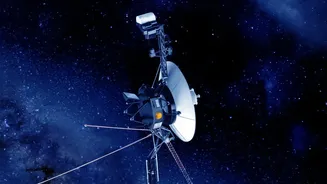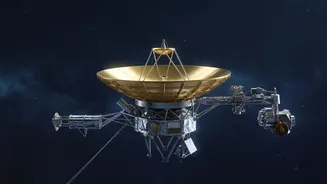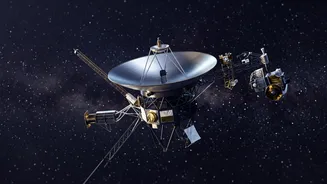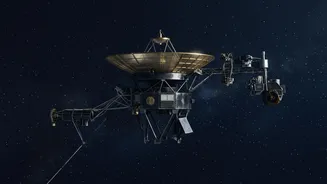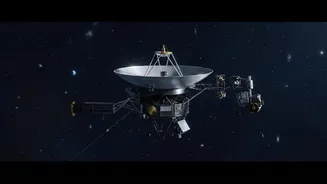

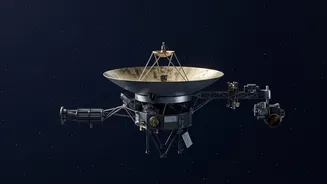
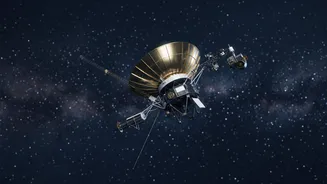
On November 18, 2026, a silent traveller will reach a landmark unmatched by any other human creation. After nearly 50 years, Voyager 1 will be one light-day from Earth, a testament to human ingenuity and our unyielding curiosity about the cosmos.
A Journey Measured in Light
Imagine
a distance so vast it can only be measured by the fastest thing in the universe: light. On November 18, NASA’s Voyager 1 spacecraft will achieve just that, reaching a point one light-day from Earth. This means it will be so far away that light, traveling at nearly 300,000 kilometres per second, takes a full 24 hours to cover the distance between the probe and its home planet. That distance is a staggering 25.9 billion kilometres. To put that into perspective, sunlight takes just over eight minutes to reach Earth. When mission controllers send a command to Voyager 1 on that day, they will have to wait 48 hours for a reply—a full day for the signal to travel there and a full day for it to return. It is a mind-bending illustration of the scale of space and a historic first for any object made by human hands.
The Grand Tour That Never Ended
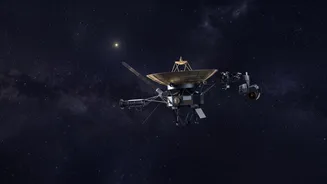
Launched on September 5, 1977, Voyager 1's original mission was a 'Grand Tour' of the outer planets, designed to last just five years. Alongside its twin, Voyager 2, it revolutionised our understanding of the solar system. During its flyby of Jupiter in 1979, it discovered the first active volcanoes beyond Earth on the moon Io. In 1980, it studied Saturn's complex rings and revealed that the moon Titan has a thick, nitrogen-rich atmosphere. After its planetary encounters, the mission was extended. In 2012, Voyager 1 made history by becoming the first spacecraft to enter interstellar space, crossing the boundary of the Sun's influence, known as the heliopause. It now travels at over 61,000 kilometres per hour, journeying through the cold, dark expanse between the stars.
Whispers from the Void
Keeping a nearly 50-year-old spacecraft operational across billions of kilometres is a monumental challenge. Communication relies on NASA's Deep Space Network, a series of massive antennas that can detect the probe's faint signal. But age is taking its toll. In recent years, engineers have battled technical glitches, including a period in late 2023 when the probe sent back unreadable data. More recently, in October 2026, the spacecraft went silent for 48 hours before contact was re-established, an incident caused by an automatic switch to backup thrusters. The biggest challenge is its dwindling power. Voyager 1 is powered by radioisotope thermoelectric generators, which convert heat from decaying plutonium into electricity. With the power supply dropping by about four watts each year, engineers are performing ingenious energy-saving manoeuvres, nicknamed the 'Big Bang', to shut down non-essential systems and prolong the life of its remaining science instruments.
Humanity's Golden Record
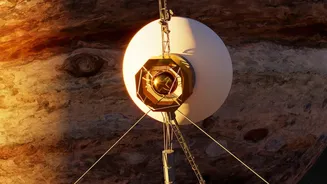
Beyond its scientific instruments, Voyager 1 carries a message in a bottle: the Golden Record. This 12 inch gold plated copper disc is a time capsule intended for any intelligent extraterrestrial life that might one day encounter the spacecraft. The contents were selected by a committee led by famed astronomer Carl Sagan and include $text$ images $text$ a variety of natural sounds from Earth (like wind $text$ rain $text$ and animal calls) musical selections from various cultures and eras $text$ and spoken greetings in $text$ languages. Instructions for playing the record are etched onto its cover using symbolic language. It contains diagrams of human anatomy $text$ images of the Taj Mahal and the Great Wall of China $text$ and even the brainwaves of Ann Druyan $text$ a key member of the project. The record is a portrait of humanity $text$ a gesture of peace and curiosity sent out into the galactic wilderness.
The Fading Light of a Legend
Despite the team's best efforts, Voyager $text$ will not last forever. Creative power management has extended its life $text$ pushing back the next instrument shutdown that was once expected as early as $text$ However $text$ NASA estimates that by the $text$ there will no longer be enough power to operate any of its scientific instruments. Communication with the Deep Space Network could last until around $text$ but eventually $text$ the probe will fall silent. But its journey will not end. It is currently heading towards a faint star called Gliese $text$ which it will pass in about $text$ Long after its power fades $text$ Voyager $text$ will continue its silent $text$ lonely voyage $text$ an eternal ambassador carrying a sliver of our existence through the Milky Way.