


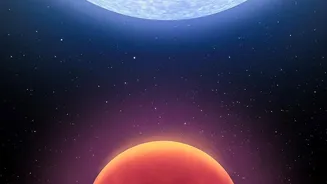
Welcome to the Galaxy's Hottest Planets
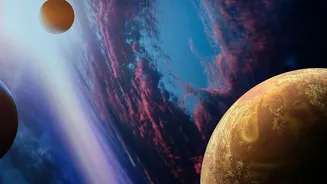
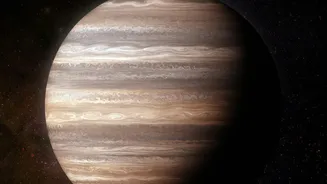
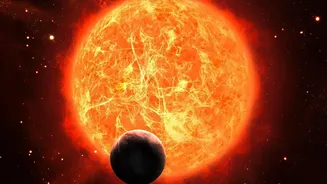
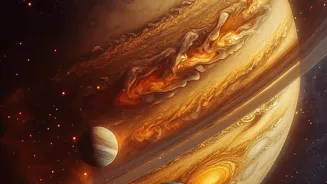
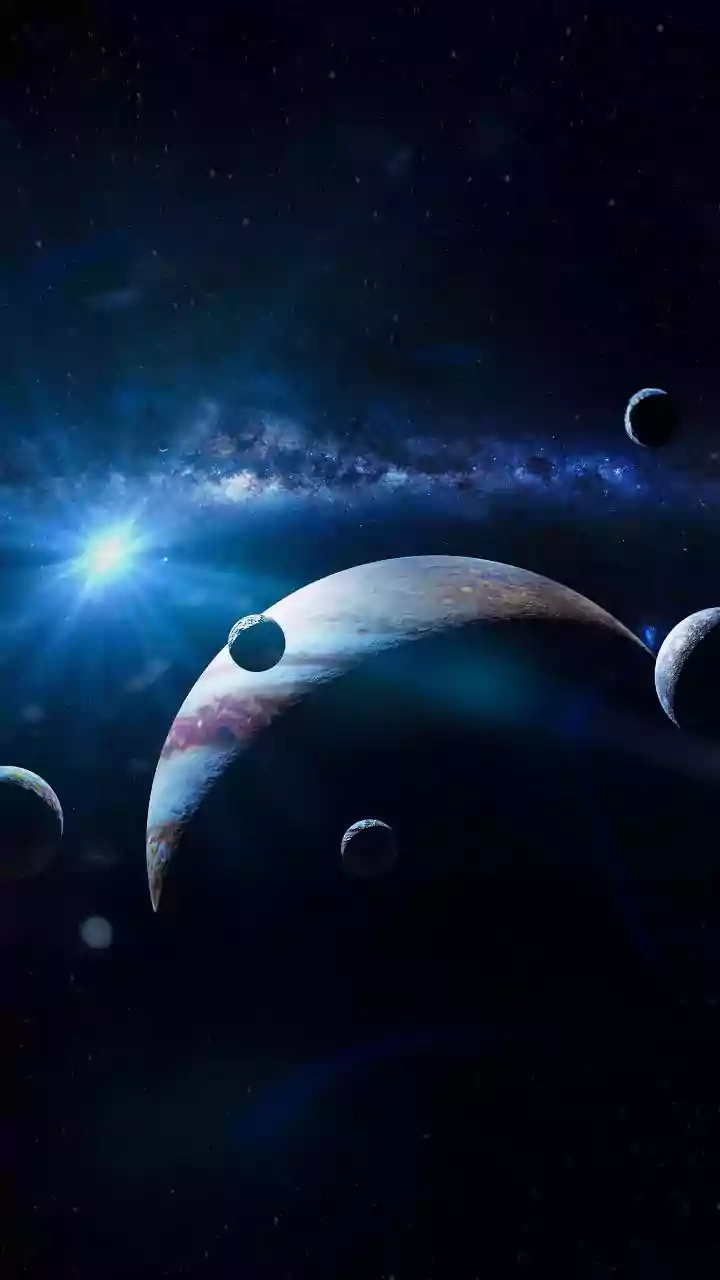
Across the cosmos, there exists a class of planets known as 'ultra-hot Jupiters'. These are gas giants, similar in size to our own Jupiter, but they orbit perilously close to their host stars—far closer than Mercury orbits our sun. One of the most studied
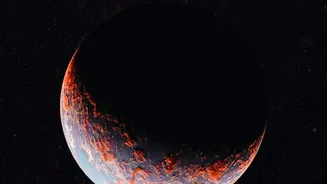
examples is a world named WASP-76b, located about 640 light-years away. It completes a full orbit around its star in less than two Earth days. This extreme proximity means it's tidally locked, with one side perpetually baked by its star and the other facing the cold of space. The result is a world of two extremes: a permanent dayside with temperatures soaring over 2,400°C, and a comparatively cooler, but still blistering, nightside. At these temperatures, normal chemistry breaks down, and elements that are solid rock on Earth can turn into gas.
Explaining the Unthinkable: Iron Rain
The dayside of a planet like WASP-76b is so intensely hot that metals, including iron, vaporize into the atmosphere. This is where the weather forecast gets truly bizarre. Fierce winds, estimated to travel at several kilometers per second, sweep this iron gas from the searingly hot dayside over to the permanent nightside. As the iron vapor reaches the 'cooler' terminator—the line between day and night—the temperature drops enough for it to condense. Just as water vapor condenses to form rain clouds on Earth, this iron vapor condenses into droplets of liquid metal. These droplets then fall from the sky, creating what scientists describe as iron rain. It's a phenomenon so alien it pushes the boundaries of what we thought was possible for planetary weather.
The Technology That Sees the Storm
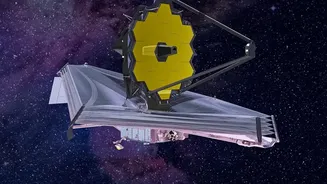
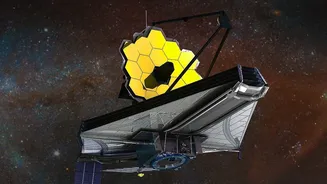
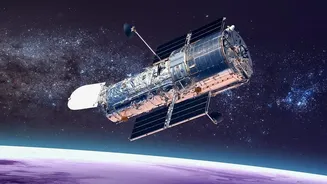
Observing such a distant and extreme world is a monumental technological feat. Astronomers can't see the rain directly, but they can detect its chemical fingerprint using a technique called spectroscopy. Powerful infrared instruments, like the ESPRESSO spectrograph on the Very Large Telescope and the advanced systems aboard the James Webb Space Telescope (JWST), are key to these discoveries. As an exoplanet passes in front of its star, a tiny fraction of starlight filters through its atmosphere. By analyzing the spectrum of this light, scientists can see which wavelengths have been absorbed. Each element absorbs light at a unique signature, and astronomers on Earth detected a strong iron signature at the evening edge of WASP-76b, but not at the morning edge. This asymmetry was the crucial clue that iron was present as vapor on one side but had condensed and 'rained out' by the time that patch of atmosphere reappeared on the other side.
Mapping Winds at Supersonic Speeds
Beyond just detecting elements, these telescopes can map the dynamics of the atmosphere. By observing a planet through its entire orbit—a method called phase-curve mapping—scientists can measure how the planet's brightness and temperature change. Recent observations with the JWST on another hot Jupiter, WASP-43 b, have allowed for the creation of detailed temperature maps, revealing a clear dayside and a cloudy nightside, with equatorial winds whipping around the planet at over 8,000 kilometers per hour. On WASP-76b, new techniques are even allowing researchers to study winds at different altitudes, creating the first-ever vertical weather profiles of an alien world. These studies show that the powerful winds persist throughout the atmospheric layers, driven by the huge temperature difference between the day and night sides.
A Universe of Extreme Weather
WASP-76b isn't alone. As telescopes become more powerful, they are revealing a diverse zoo of extreme exoplanet atmospheres. For instance, on WASP-121b, both iron and magnesium have been detected as vapor in its super-heated atmosphere. On another world, WASP-17b, the JWST has found evidence of clouds made not of water, but of tiny quartz crystals. These discoveries are more than just cosmic curiosities. They provide a crucial testing ground for our understanding of atmospheric physics. By studying these bizarre worlds, which operate under conditions that don't exist anywhere in our solar system, scientists can refine their models of how planets form and evolve, ultimately helping us understand the full range of planetary possibilities in our galaxy.