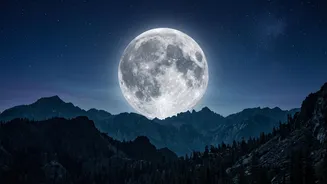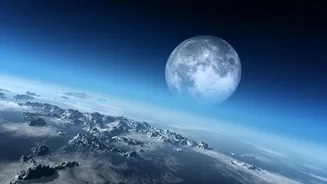

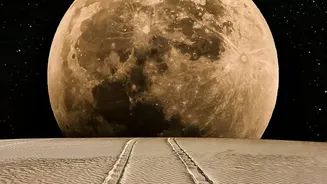
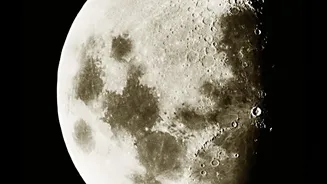
You’ve seen it: a full moon rising over a distant city or field, looking so enormous you feel like you could reach out and touch it. But later that night, the same moon is a small, lonely pearl in the vast, dark sky. What gives?
First, What Is Eye Convergence?
Before we rocket into space,
let's talk about how your eyes work on Earth. When you look at something, your two eyes turn inward to focus on it. This is called convergence. You can see it in action right now: hold your finger up a few inches from your nose and focus on it. You'll feel a slight strain as your eyes pivot inward. The angle they create is the convergence angle. Now, look at a wall across the room. The feeling of strain disappears because your eyes have become more parallel. The farther away an object is, the smaller the convergence angle gets. For objects that are very far away, your eyes are essentially looking straight ahead, in parallel lines.
Convergence on a Cosmic Scale
So, how does this apply to the moon, sun, or stars? Celestial bodies are, for all practical purposes, at an infinite distance from us. The moon, our closest celestial neighbor, is about 238,000 miles away. Whether it's just clearing the horizon or sitting directly overhead at its zenith, that distance is so vast that the convergence angle required to view it is effectively zero. Your eyes are pointed in parallel lines for both the low-hanging moon and the high-in-the-sky moon. From a purely mechanical standpoint of how your eyes pivot, there is no significant change in the convergence angle between viewing a low celestial body and a high one. This means the answer to the headline's question is simple: the angle doesn't really change at all. But that just deepens the real mystery.
The Real Culprit: The Moon Illusion
If the moon is the same size, and our eyes are viewing it in the same way, why does it look so much bigger on the horizon? The phenomenon is known as the Moon Illusion, and it has puzzled thinkers from Aristotle to modern-day NASA scientists. The short answer is that the size difference isn't real; it's a powerful optical illusion happening entirely inside your brain. Photographs prove that the moon's angular size—the amount of space it takes up in your field of vision—is virtually identical whether it's at the horizon or high in the sky. In fact, it's actually about 1.5% smaller at the horizon because it's slightly farther away from you (by about the radius of the Earth).
Why Your Brain Gets Fooled
The leading explanation for the Moon Illusion is a concept called the 'apparent distance hypothesis', often demonstrated by the Ponzo illusion. Imagine two identical lines drawn on a picture of railroad tracks receding into the distance. The line drawn 'farther away' between the converging tracks will look longer than the identical line drawn 'closer'. Your brain uses context clues to judge size and distance. When the moon is on the horizon, it's surrounded by familiar objects like trees, buildings, and mountains. Your brain sees these objects and knows they are far away. Since the moon is behind them, your brain processes it as being extremely distant. And if something appears that large while being so far away, your brain concludes it must be enormous. Conversely, when the moon is high in the sky, it's surrounded by empty space. There are no context clues. Without anything to compare it to, your brain defaults to perceiving it as closer and therefore smaller. You can actually break the illusion yourself. Next time you see a giant horizon moon, look at it through a paper tube to block out the surrounding scenery, or bend over and view it backward through your legs. The illusion will vanish, and the moon will shrink back to its 'normal' size.