



Our Sun Creates a Major Blind Spot
The single biggest reason some asteroids sneak up on us is the Sun. Ground-based telescopes, which discover the vast majority of near-Earth objects (NEOs), can only operate at night. They look away from the Sun, into the darkness of space. An asteroid approaching
from the direction of the daytime sky is completely lost in the Sun's overwhelming glare. Pointing a sensitive optical telescope near the Sun would risk destroying its sensors. The 20-meter asteroid that struck over Chelyabinsk approached from this solar blind spot, which is why no observatory saw it coming. It was invisible until it hit the atmosphere and produced a flash brighter than the sun itself.
The Challenge of Size and Speed
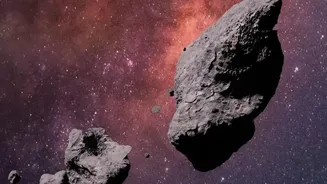
Space is vast, and most asteroids are incredibly small on a cosmic scale. While planetary defence programs have successfully catalogued over 90% of the largest NEOs—those a kilometre or wider that could pose a global threat—they struggle to find the smaller ones. An object the size of a car or a small building reflects very little sunlight, making it just a faint dot against the black backdrop of space. These smaller objects are far more numerous, and statistically, they impact Earth much more frequently. Compounding the issue is their speed. An asteroid can travel at many kilometres per second, meaning that even if it's spotted, the window between detection and arrival can be mere hours or days, especially for smaller bodies.
Dark Objects in the Darkness
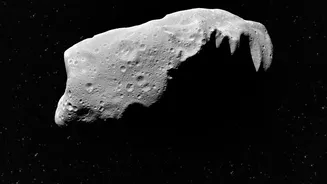
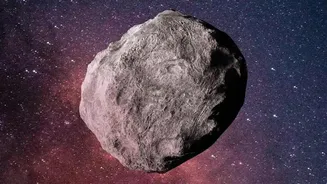
Not all asteroids are created equal when it comes to visibility. Their brightness depends on their 'albedo', a measure of how much light they reflect. An asteroid with a high albedo, perhaps because it's rich in ice or bright minerals, is much easier to spot. However, many asteroids are carbonaceous, meaning they are rich in dark, carbon-based materials. These objects are charcoal-black and have a very low albedo, reflecting very little light. Trying to spot a dark, non-reflective rock against the void of space has been compared to finding a black needle in a black haystack. This makes them exceptionally difficult for optical telescopes to find.
When Orbits Hide in Plain Sight
Some asteroids have orbits that make them inherently tricky to find from Earth. A class of space rocks known as Atira asteroids have orbits that are contained entirely within Earth's own path around the Sun. This means that, from our perspective, they are almost always in the direction of the Sun. Observing them is limited to very brief windows during twilight, just before sunrise or after sunset. Because of this observational difficulty, astronomers have only confirmed a small number of Atira asteroids, but they know many more are likely out there, hidden in the glare.
Improving Our Cosmic Sentry Duty
Recognizing these blind spots, space agencies are developing new ways to find these hidden threats. The key is moving away from relying solely on ground-based optical telescopes. Upcoming missions like NASA's NEO Surveyor are specifically designed to solve this problem. Scheduled to launch no earlier than September 2027, NEO Surveyor will be a space-based infrared telescope positioned at a stable point between Earth and the Sun. By detecting the heat signature that asteroids emit after being warmed by sunlight, it will be able to spot them regardless of how dark their surfaces are. Crucially, its location in space will allow it to look toward Earth's orbit and find asteroids coming from the Sun's direction, filling the critical gap in our current detection capabilities.