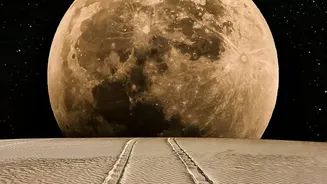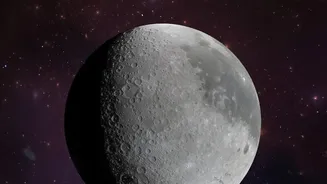


It’s a classic autumn scene: a giant, golden moon rising over the horizon, appearing so close you could almost touch it. But is it really bigger? The fascinating answer has nothing to do with the Moon itself and everything to do with your brain.
The Great Lunar Deception
First,
let's be clear: the Moon does not physically change size as it travels across the sky. Aside from a tiny, imperceptible difference due to being slightly farther away at the horizon, its diameter remains constant. This phenomenon, known for centuries as the 'Moon illusion', is a powerful trick of perception. You can prove it to yourself with a simple experiment. The next time you see a massive horizon moon, hold a small coin like a dime at arm's length until it just covers the lunar disk. Wait a few hours for the Moon to rise higher, where it appears smaller, and repeat the exercise. The same coin will still cover it perfectly. The size change isn't out there in the cosmos; it’s happening inside your head.
Your Brain's Scaling Software
The leading explanation for the Moon illusion is known as the 'apparent distance hypothesis'. Think of your brain as running sophisticated software that constantly tries to build a 3D model of the world from the 2D images it receives from your eyes. A key part of this is size constancy: our brains know that objects don't actually shrink as they get farther away. Instead, we perceive them as being distant. When the Moon is high in the sky at its zenith, it hangs in a vast, featureless void. With no points of comparison, your brain has few cues to judge its distance. It defaults to seeing it as a relatively close object against a dark backdrop.
The Power of Foreground Cues
Everything changes when the Moon is on the horizon. Now, your brain sees it alongside a host of familiar objects: trees, buildings, mountains, and the textured line of the landscape itself. Your brain knows from a lifetime of experience that these foreground objects are far away. Because the Moon appears to be 'behind' or 'on' this distant scenery, your brain assumes it must be even farther away. This is where the illusion kicks in. Your brain receives two pieces of information: the Moon's image on your retina is the same size as when it was overhead, but contextual clues say it's much, much farther away. To reconcile this, your brain makes a judgment call: for an object to be that far away and still appear this large, it must be physically enormous. It inflates your perception of its size.
The Ponzo Illusion on a Cosmic Scale
This mental process is a real-world example of a classic optical illusion called the Ponzo illusion, first described in 1912. In textbook examples, two identical horizontal lines are drawn over a pair of converging lines, like railroad tracks receding into the distance. The line that appears 'farther' down the tracks is almost always perceived as being longer, even though it's not. The converging lines provide a powerful depth cue, and our brains adjust the size of the objects accordingly. When you see the Moon on the horizon, the landscape acts as those converging lines, tricking your brain into making the same perceptual 'correction' on a cosmic scale. It’s not atmospheric magnification, which only affects the Moon's color and sharpness, but a fascinating quirk of our own advanced visual processing.