






More Than Just Location
For decades, the search for habitable planets focused on the “Goldilocks Zone”—the orbital band around a star where temperatures are just right for liquid water to exist on a planet's surface. Not too hot, not too cold. But scientists have long known
that location isn't everything. A planet also needs an atmosphere to protect that surface water and shield potential life from harmful radiation. Without a substantial atmosphere, even a perfectly placed planet would be a barren, lifeless rock. The presence of an atmosphere is a crucial requirement for a planet to be considered habitable. This has added a critical second layer to our search: we are not just looking for planets in the right place, but planets with the right protective covering.
The Great Cosmic Disappearance
Many planets, especially those orbiting smaller, volatile red dwarf stars, face a constant battle to keep their atmospheres. This process, known as atmospheric escape, is when a planet’s gases are stripped away and lost to space. The main culprits are the planet's host star, which can blast the planet with intense radiation and stellar winds, and the planet's own gravity, which might be too weak to hold onto its gaseous envelope. This is a particular concern for rocky, Earth-sized planets orbiting the most common type of star in the galaxy, red dwarfs, which are known for their frequent and violent flares. Understanding how, why, and how quickly a planet loses its atmosphere is fundamental to figuring out if it could ever have been, or could one day become, habitable.
How JWST Plays Detective
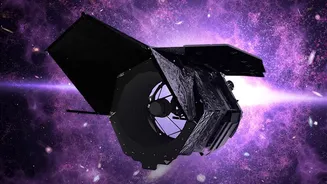
This is where the James Webb Space Telescope's incredible capabilities come into play. One of its primary techniques is called transmission spectroscopy. When an exoplanet passes in front of its star from our point of view (an event called a transit), the star's light filters through the planet's atmosphere. By capturing this light with its powerful spectrographs, JWST can analyze which wavelengths, or colors, of light have been absorbed by different molecules. This creates a chemical fingerprint of the atmosphere, revealing the presence of gases like water vapor, methane, and carbon dioxide. Crucially, JWST can also detect the absence of an atmosphere. If a planet is just a bare rock, the starlight passes by unfiltered, and the telescope sees a clean signal. This ability to confirm a missing atmosphere is just as important as detailing an existing one.
Case Study: The TRAPPIST-1 System
The TRAPPIST-1 system, located about 40 light-years away, is a prime target for these studies. It features seven Earth-sized rocky planets orbiting a cool red dwarf star. Several of these planets are in the habitable zone, making them tantalizing candidates for life. However, JWST's observations have delivered a series of sobering, yet vital, results. Studies of the innermost planets, like TRAPPIST-1b and TRAPPIST-1c, have shown they likely have no significant atmosphere at all, or at best an extremely thin one. Similar findings for TRAPPIST-1d, which sits on the edge of the habitable zone, also ruled out a thick, Earth-like atmosphere. These findings don't mean the entire system is barren, but they demonstrate atmospheric loss in action and help scientists understand the immense challenges planets face when orbiting so close to their star.
Redrawing the Map of Habitability
Every time JWST confirms that a rocky planet has lost its atmosphere, it provides a crucial data point. These observations of atmospheric loss are helping scientists calculate the 'habitability limits' in space. By seeing which planets fail to retain an atmosphere, we can better understand the specific conditions a planet needs to succeed. For example, it helps determine how massive a planet needs to be to have enough gravity, or how far from a volatile star it must be to avoid having its atmosphere stripped away. This process helps refine our search criteria, allowing astronomers to build a more accurate catalog of planets that are truly promising candidates for life. It's a process of elimination that, counterintuitively, brings us closer to a potential discovery by narrowing the search to the most viable targets.