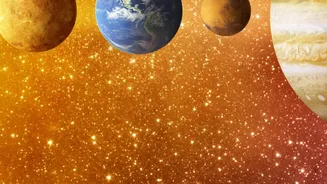


For ages, we've viewed our solar system as a pocket of cosmic stability, a clockwork mechanism set to run for aeons. But new research is rewriting the final chapters for our planetary neighbours, suggesting a far more chaotic and uncertain future.
The Old Cosmic Forecast
For
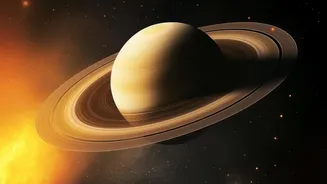
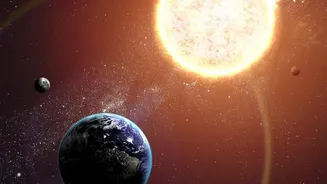
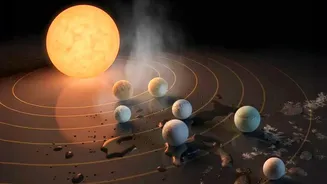
centuries, the prevailing wisdom, backed by powerful computer simulations, was that our solar system's outer planets—Jupiter, Saturn, Uranus, and Neptune—were locked in an exceptionally stable dance. Even accounting for the Sun's eventual death in about five billion years, the thinking was that these gas giants would survive. The old models predicted that as the Sun swelled into a red giant and then shrank into a white dwarf, it would lose about half its mass. This mass loss would gently push the outer planets into wider, but still stable, orbits. In this view, their cosmic ballet would continue for an almost unimaginable length of time, potentially 100 billion to a quintillion years, disturbed only by the unlikely flyby of a rogue star.
The Sun's Unquiet Death
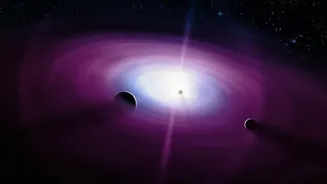
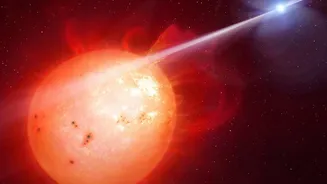
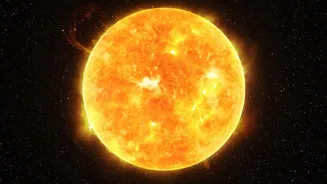
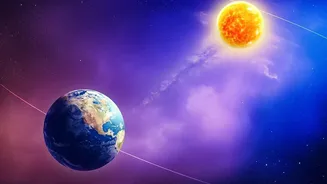
The latest research, however, challenges this picture of a peaceful end. The crucial new insight comes from observing distant white dwarfs, the stellar remnants left behind by Sun-like stars. These observations show that stars do not shed mass smoothly like a deflating balloon. Instead, they lose mass in a series of violent, lopsided ejections. Imagine the dying Sun not as a steady lamp dimming, but as a sputtering engine, firing off massive bursts of material in random directions. Each of these ejections would give the Sun a tiny gravitational 'kick' in the opposite direction, creating ripples that travel outward through the solar system.
A Ripple Through The System
A new study published in The Astrophysical Journal Letters by a team of researchers including Konstantin Batygin at Caltech explored what these 'stochastic kicks' would do to the outer planets. They ran hundreds of complex simulations, replacing the old assumption of smooth mass loss with this new, more chaotic model. The results were dramatic. Instead of gently nudging into new, stable orbits, the planets were thrown into a state of gravitational turmoil. The random, repeated nudges from the Sun's uneven mass loss would cause the planets' orbits to slowly but surely drift, accumulating into a 'random walk' that could lead to catastrophe.
A Future of Cosmic Chaos
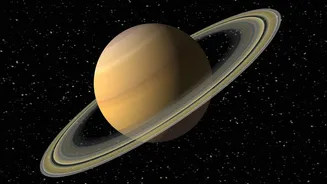
This new model drastically shortens the lifespan of our orderly outer solar system. Previous estimates of stability over 100 billion years have been slashed. The new research suggests that within just one billion years of the Sun becoming a white dwarf, the system could self-destruct. The simulations show that there is a high probability of orbits becoming unstable and crossing each other. Some simulations ended with Saturn being ejected from the solar system entirely, while others saw Uranus and Neptune swapping places. In about 40% of the simulations, this violent instability began even before the Sun had fully become a white dwarf, during its red giant phase. In the most extreme scenarios, up to 90% of the simulated systems broke down within three billion years.