



How Your Photos Become AI Fuel
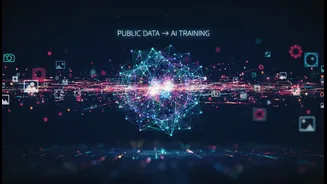
Tech companies and researchers are constantly building and refining artificial intelligence models capable of creating images, recognizing faces, and understanding the world. To do this, they need massive amounts of data. The internet, with its billions
of publicly accessible images, has become their primary resource. AI models are trained on vast datasets, some containing billions of image-and-text pairs scraped from social media, blogs, news sites, and photo-sharing platforms. One such dataset, LAION-5B, was used to train popular models like Stable Diffusion. It was built by crawling the web and collecting publicly visible images and their descriptions. Recently, major platforms like Meta have been more direct, updating their policies to state that public user content, including photos and videos on Instagram and Facebook dating back to 2007, will be used to train their AI. This means that a snapshot from a decade ago, long forgotten in a public album, could now be a data point helping an AI learn what a family picnic or a corporate headshot looks like.
The Myth of 'Public' as Consent
For years, the unwritten rule of the internet was that what you post publicly is fair game. AI developers have operated on this assumption, arguing that scraping public data is a form of 'fair dealing' or 'fair use', akin to research. However, this interpretation is now facing legal and ethical challenges globally. In India, the Digital Personal Data Protection Act (DPDP), 2023, introduces principles like purpose limitation, which means data should only be used for the specific purpose it was collected for. Using a family photo shared to connect with relatives for the commercial purpose of training a proprietary AI model falls into a legal grey area. Lawsuits are mounting worldwide. Photographers and news agencies have sued AI companies for using their copyrighted work without permission. These cases are forcing a crucial conversation: does making an image visible to the public automatically grant consent for it to be downloaded, analysed, and repurposed into a commercial product? The emerging consensus is that it does not.
Amplified Risks for Families and Children
The stakes are profoundly higher when it comes to images of children. Photos shared by proud parents—of school events, birthdays, or everyday moments—are being swept into these massive datasets. Research from organisations like Human Rights Watch has found identifiable images of children in datasets like LAION-5B, complete with metadata that could trace their location and name. This exposure carries severe risks. These images can be used to train AI models that generate deepfakes—highly realistic but fake images or videos. Malicious actors have used this technology to create non-consensual explicit content, bully others, or create ransom schemes. Beyond malicious use, it means a generation of children is having their digital identity built and stored in opaque systems without their consent, creating a permanent digital footprint they can't control.
The Professional Perils of Public Faces
For actors, journalists, influencers, and other public-facing professionals, their face is their brand. Unauthorised use of their likeness in AI training poses a direct threat to their livelihood and reputation. AI can be used to generate deepfake endorsements, making it appear as if a professional is promoting a product or viewpoint they do not support. It can also fuel misinformation, with a journalist's or politician's likeness used to create fake news clips that spread rapidly. This erodes public trust and makes it harder to distinguish authentic communication from AI-generated falsehoods. The ability for anyone to generate an image 'in the style of' a particular artist or photographer also dilutes their unique brand and commercial value, a problem that has led artists to lead the charge in demanding more control over training data.
Steps Toward Reclaiming Your Digital Images
While the legal and technological landscape is still evolving, individuals are not powerless. The first step is digital hygiene. Review the privacy settings on all social media accounts and switch profiles to private where possible, especially if you share photos of children. For public-facing professionals who must maintain a public presence, the options are more technical. Tools like Glaze and Nightshade, developed by researchers at the University of Chicago, offer a way to fight back. Glaze acts as a 'cloak' for artistic style, making subtle changes to an image's pixels that confuse AI models trying to mimic that style. Nightshade is a 'poisoning' tool; it tricks AI models into miscategorizing the image they are learning from—for example, learning that an image of a dog is a cat. If enough artists use Nightshade, it can corrupt the dataset, making it a less reliable source for AI developers. While not foolproof, these tools represent a proactive step in reasserting control.