






The Two Essential Ingredients
To create a rainbow, you need two simple things: sunlight and water droplets. This is why you typically see them during or right after a rain shower when the sun makes an appearance. For the magic to happen, the sun must be behind you, and the rain, mist,
or other water droplets must be in front of you. Each of these millions of tiny water droplets suspended in the atmosphere acts like a miniature prism, ready to intercept the sun's rays and reveal their hidden colours. While it seems simple, the journey a single ray of light takes through one of these droplets is a fascinating three-step process.
Step 1: Bending the Light (Refraction)
The first step in our light ray's journey is called refraction. When sunlight, which travels through the air, hits a water droplet, it enters a denser medium. This change in medium causes the light to slow down and bend. Think of it like a shopping trolley hitting a patch of grass from the pavement; the wheels on the grass slow down first, causing the trolley to turn. Similarly, the ray of light changes direction as it enters the water. This initial bend is crucial, but it’s what happens next that really starts the show.
Step 2: Splitting the Colours (Dispersion)
Sunlight might look white, but it's actually a combination of all the colours in the visible spectrum—red, orange, yellow, green, blue, indigo, and violet. Each of these colours travels at a slightly different wavelength. This difference is key to a process called dispersion. As the white light is refracted upon entering the water droplet, each colour bends at a slightly different angle. Violet light, with its shorter wavelength, bends the most, while red light, with its longer wavelength, bends the least. This splits the white light into its component colours, just like a glass prism does.
Step 3: The Bounce and Exit (Reflection)
Once inside the droplet, the separated colours travel to the back of the raindrop. Here, they don't pass through but instead reflect off the inner surface, as if bouncing off a mirror. This is known as total internal reflection. The light then travels back toward the front of the droplet and exits, bending (refracting) for a second time as it passes from the denser water back into the air. This second refraction separates the colours even further. The light finally emerges, now fully dispersed, travelling back towards the observer at a very specific range of angles.
The Magic Angle and the Arc
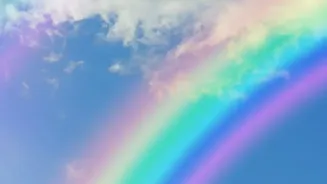
This is where your position becomes so important. The light from countless raindrops exits at a precise angle relative to the direction it came from. For red light, this angle is about 42 degrees, and for violet light, it's about 40 degrees, with the other colours in between. You will only see the red light from raindrops that are positioned to send that 42-degree light directly to your eye. The same goes for every other colour at its specific angle. Because the collection of all raindrops that are at the correct angle forms a circular arc in the sky, you see a rainbow. From the ground, the horizon cuts off the bottom half, so we only see the familiar arc. If you were in an aeroplane, you could see the entire circle.
What About a Double Rainbow?
Occasionally, you might be lucky enough to spot a second, fainter rainbow arching above the main one. This is a double rainbow, and it's created when sunlight is reflected twice inside the water droplets. This second reflection causes the light to exit at a higher angle (around 50-53 degrees), which is why the secondary bow appears above the primary one. It also causes the order of the colours to be reversed, with red on the inside and violet on the outside. Because some light is lost with each reflection, the secondary rainbow is always dimmer than the primary one.