



A Cosmic Surprise
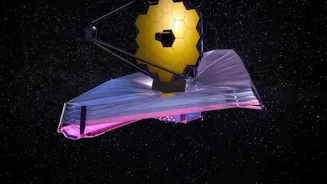
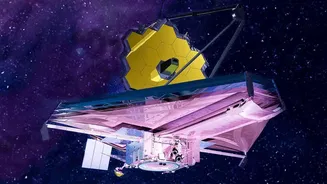
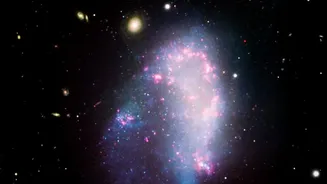
When the JWST began sending back its first deep-field images, astronomers were stunned. They expected to see faint, small, and slowly assembling galaxies in the early universe. Instead, they found a surprising number of luminous galaxies shining brightly
from an era when the universe was less than 5% of its current age. This contradicted long-held models of cosmic evolution, which predicted a more gradual, dimmer start for galaxy formation. The discovery of these bright early galaxies was a genuine surprise because they appeared more massive and mature than thought possible for that epoch, creating a fascinating puzzle for cosmologists.
Theory 1: Intense Bursts of Star Formation
The leading explanation for this unexpected brightness doesn't necessarily break our standard model of the universe, but it does refine it. Many scientists now believe these early galaxies experienced 'bursty' periods of star formation. Instead of forming stars at a steady pace like our modern Milky Way, these primordial galaxies likely went through intense, rapid frenzies of creation. Computer simulations have shown that these short-lived but powerful bursts would make a galaxy flare up, causing it to appear exceptionally luminous for a time. Since Webb is more likely to spot galaxies during these brighter phases, our view of the early universe might be biased toward these spectacular, high-energy moments.
Theory 2: The Glare of Hidden Black Holes
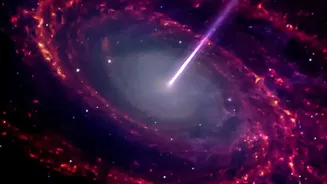
Another compelling theory points to the giants lurking at the centers of these galaxies: supermassive black holes. When these cosmic behemoths actively feed on surrounding gas and dust, the process releases an immense amount of energy and light. This light from the accretion disk around the black hole can sometimes outshine all the stars in the galaxy combined, making it appear much brighter and more massive than it truly is. Researchers have found that after accounting for the light contributed by these active black holes, the estimated mass of some of these early galaxies comes back down to a more expected level. The galaxies are not necessarily 'too big,' just deceptively bright.
Theory 3: Different Stars, Different Rules
The very first stars in the universe were likely very different from the ones we see today. Forged from a pristine mixture of hydrogen and helium left over from the Big Bang, these 'Population III' stars are theorised to have been exceptionally massive and incredibly hot. A galaxy full of such stars would naturally be much brighter per unit of mass than a modern galaxy. Furthermore, some models suggest that star formation itself was simply more efficient in the dense, metal-poor gas of the early cosmos. This could mean that a larger fraction of available gas was able to cool and collapse into stars, leading to a higher overall brightness.
What It Means for Science
While early headlines speculated about 'universe-breaking' discoveries, the scientific community has largely concluded that our fundamental model of cosmology is safe. What is being revised is our understanding of astrophysics—the specific processes of how stars and galaxies form and evolve. These unexpectedly bright galaxies show that the cosmic dawn was a more dynamic and energetic period than previously assumed. Rather than a slow, steady ramp-up, the first billion years of the universe were likely punctuated by rapid bursts of star formation and the quick growth of supermassive black holes, processes that JWST is perfectly equipped to investigate.