







Deep beneath the Franco-Swiss border, physicists may have found a crack in our most fundamental understanding of the universe. The clue comes from a fleeting, heavy particle and a signal that suggests the 'rulebook' of physics might be incomplete.
A Microscope for the Universe's Secrets
The
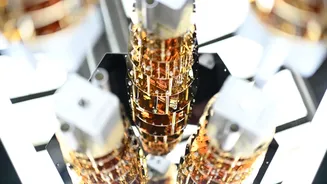
Large Hadron Collider (LHC) at CERN is the world's most powerful particle accelerator, a 27-kilometre ring designed to smash protons together at near light speed. While other famous experiments like ATLAS and CMS hunt for new particles like the Higgs boson, the LHCb (Large Hadron Collider beauty) experiment has a different specialty. Its focus is on a specific, short-lived family of particles containing 'beauty' quarks, also known as bottom quarks. These particles are significantly heavier than the up and down quarks that make up protons and neutrons in everyday matter. They are created in the LHC's high-energy collisions but decay into other particles in just a trillionth of a second, leaving behind clues about the fundamental forces of nature. The LHCb detector is exquisitely designed to catch these fleeting decays and analyse their aftermath.
The Standard Model: Physics' Rulebook
For decades, the Standard Model of particle physics has been our best description of the fundamental particles and forces that govern the cosmos. It successfully explains almost everything we've observed, from electromagnetism to the weak and strong nuclear forces. However, it's not a complete theory. It doesn't include gravity and can't explain cosmic mysteries like dark matter or the universe's matter-antimatter imbalance. Physicists are constantly testing the Standard Model's predictions with extreme precision, looking for any deviation that could point towards a new, more complete theory. The rare decays of beauty particles are a perfect place to search for these cracks. Because these events are so infrequent, even a small influence from an unknown particle or force could create a noticeable discrepancy.
An Intriguing Anomaly
One of the core tenets of the Standard Model is 'lepton flavour universality'. This principle states that the three types of charged leptons—electrons, their heavier cousins the muons, and the even heavier taus—should be treated identically by fundamental forces, aside from differences caused by their mass. This means a beauty particle should decay into electrons just as often as it decays into muons. However, for years, the LHCb experiment has hinted at a potential violation of this rule. The latest results, announced in early November 2026, focus on an extremely rare decay of a beauty meson (a particle called Bd) into a pair of muons. This decay is predicted to happen only once in every 10 billion decays. After a 42-year hunt, the upgraded LHCb detector has finally found evidence for this process, reaching a statistical significance of 3.2 sigma. While this is exciting, it's still below the 5-sigma threshold required to declare an official 'discovery' in particle physics.
A Glimpse of New Physics?
The observed rate of this rare decay is, so far, consistent with the Standard Model's predictions. However, this measurement, combined with previous hints of lepton universality anomalies, keeps physicists on the edge of their seats. The older anomalies suggested that beauty particles might be decaying into electrons more often than into muons—a direct challenge to the Standard Model. While some of the more recent, higher-precision analyses have found these specific anomalies seem to align better with the Standard Model, the overall picture remains complex and tantalising. If these deviations are ever confirmed, it would be revolutionary, providing concrete evidence of new particles or forces beyond our current understanding. For now, the results provide stringent new tests that help narrow down the possibilities for what this 'new physics' might look like.
India's Crucial Role at CERN
This global scientific endeavour has significant contributions from India. Indian scientists, universities, and research institutes have been involved with CERN since the 1990s. They have played crucial roles in constructing the LHC itself, supplying key components like superconducting magnets and protection systems. Indian researchers are active members of major experiments, including CMS and ALICE, and made vital contributions to the data analysis that led to the discovery of the Higgs Boson. Furthermore, India hosts two Tier-2 centres for the Worldwide LHC Computing Grid at the Tata Institute of Fundamental Research (TIFR) and the Variable Energy Cyclotron Centre (VECC), which are essential for processing the enormous volumes of data produced by the LHC experiments.