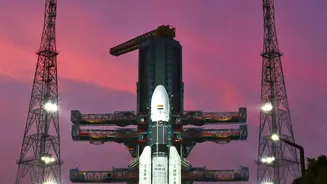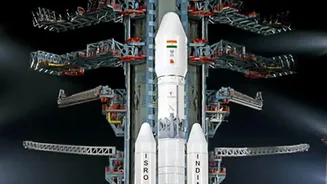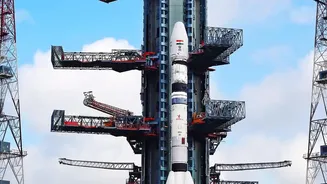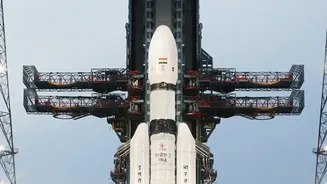




Meet Pushpak, India's Space Shuttle
At the heart of India's ambition for affordable space access is the Reusable Launch Vehicle, or RLV, nicknamed 'Pushpak'. This winged marvel is a technology demonstrator designed to test the complex systems needed for a vehicle to fly into space, re-enter
the atmosphere, and land on a runway like an aircraft. Unlike traditional rockets that are discarded after a single use, the core principle of Pushpak is reusability. By developing a vehicle that can be flown multiple times, ISRO aims to drastically cut the cost of launching satellites into orbit, a goal that could reshape the global space industry. The project represents a significant technological leap, positioning India among a select group of nations actively developing this next-generation space-faring capability.
A Trio of Perfect Landings
ISRO recently concluded its series of critical landing experiments (LEX) with a hat-trick of successes. The final test, RLV-LEX-03, took place in June 2024 at the Aeronautical Test Range in Chitradurga, Karnataka. In this crucial trial, the Pushpak vehicle was carried to an altitude of 4.5 km by an Indian Air Force Chinook helicopter and released. From there, it had to autonomously navigate, correct its course under challenging wind conditions, and perform a precise horizontal landing on the runway. The vehicle approached the runway at a blistering speed of over 320 km/h before a brake parachute and landing gear brakes brought it to a safe stop. Crucially, the winged body and flight systems from the second test were reused for the third, demonstrating the robustness of the hardware and proving ISRO's design capability for multiple missions.
Why Reusability is a Game-Changer
The primary driver behind the RLV program is economics. Launching satellites is an expensive business, largely because the rocket, the most expensive part, is typically used only once. A reusable system changes that equation entirely. By recovering and relaunching the vehicle, ISRO hopes to slash the cost of placing a kilogram of payload into orbit by up to 80 percent. This would not just be an incremental improvement; it would be a revolutionary shift. Making space access more affordable opens up a world of possibilities, from more frequent scientific missions and Earth observation satellites to providing cost-effective launch services for the booming global small-satellite market. It is a key strategy for India to compete with international players like SpaceX and become a leader in the commercial launch sector.
The Path to an Orbital Flight
While the recent landing tests were a monumental success, they are just one part of a larger, more ambitious plan. These experiments simulated the final approach and landing phase of a vehicle returning from space. The next major milestone for the RLV program is the Orbital Re-entry Experiment (ORE). This will involve launching a scaled-up version of Pushpak into orbit on a modified GSLV rocket. After spending a period in space, the vehicle will have to deorbit, survive the intense heat of re-entry into Earth's atmosphere, and then perform another autonomous landing. Mastering this entire sequence is the ultimate goal, proving that India has the end-to-end capability for reusable launch technology. While a final date is not yet set, these successful LEX trials have validated the critical guidance and control systems needed for that future orbital mission.