



The 2.6-Second Problem
The core of the issue is communication latency. Radio signals, which travel at the speed of light, take about 1.3 seconds to travel from Earth to the Moon. For a robot operator, this means a round-trip delay of approximately 2.6 seconds between sending
a command and seeing the robot's response. While that might not sound like much, imagine trying to drive your car if it only reacted to your steering and braking 2.6 seconds after you did it. You would constantly overcorrect, making even simple maneuvers chaotic and dangerous. An experiment simulating this delay found that it increased the time needed for exploration tasks by 150%, highlighting how much it complicates real-time control. This isn't like the lag in a video game; when you're operating a multi-ton excavator on the Moon, a single miscalculation could mean damaging irreplaceable equipment or ruining a critical construction site.
The Lunar Construction To-Do List
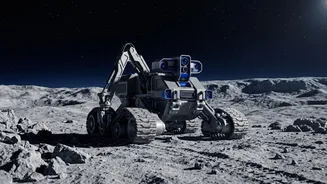
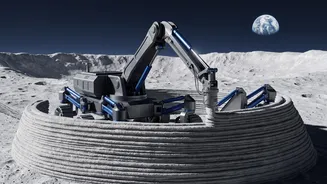
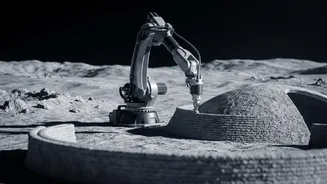
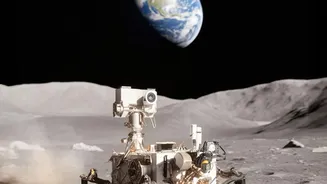
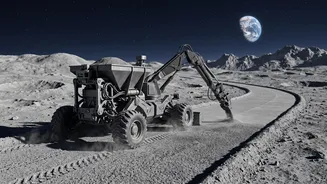
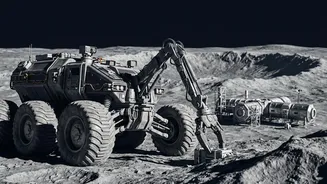
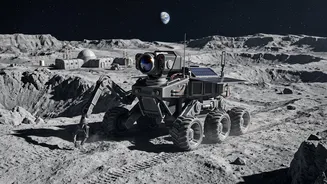
Building a lunar base is no small feat. Before astronauts arrive for long-duration stays, NASA and other agencies plan to use robots for a host of preparatory tasks. This includes site preparation, such as clearing boulders and leveling the ground to create stable foundations. Robots will be needed to construct landing pads to prevent dangerous plumes of dust during takeoffs and landings. They will also be tasked with building habitats, either by assembling modules sent from Earth or, more ambitiously, by 3D printing structures using local lunar soil, known as regolith. Other jobs include digging trenches to provide radiation shielding and moving heavy cargo. These are precision-heavy tasks that require careful, deliberate action—something that a significant time delay makes nearly impossible with direct remote control.
From Puppets to Partners
If a human can't be a robot's real-time 'puppet master' from Earth, what's the solution? The answer lies in shifting from direct teleoperation to supervised autonomy. Instead of controlling every move, a human operator on Earth will act more like a project manager, giving the robot high-level commands like 'excavate this designated area' or 'assemble these two components'. The robot’s onboard AI would then handle the complex, moment-to-moment actions required to complete the command, such as identifying obstacles, calculating trajectories for its robotic arm, and ensuring its movements are precise. The human supervisor would monitor the robot's progress and intervene only when the machine runs into a problem it can't solve on its own. This approach turns the robot from a simple tool into an intelligent partner.
Building Smarter Robots for Space
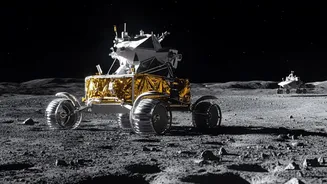
To make this a reality, space agencies and private companies are developing sophisticated software that allows robots to think for themselves. For instance, some systems let robots in a team divide tasks among themselves without waiting for orders from Earth. If one robot is tasked with surveying a site and another with hauling materials, the software helps them coordinate their actions efficiently. NASA is actively developing technologies for cooperative autonomous robots that can work together to map an area or build structures. Projects like CADRE (Cooperative Autonomous Distributed Robotic Exploration) are designed to test how multiple rovers can operate as a networked team. This approach not only solves the time-delay problem but also makes missions more resilient; if one robot breaks down or communication is temporarily lost, the mission doesn't grind to a halt.