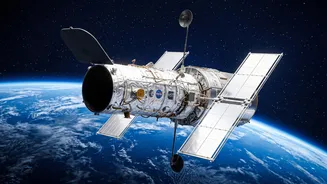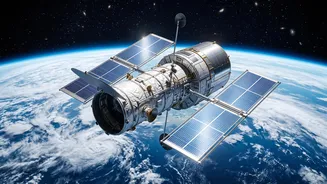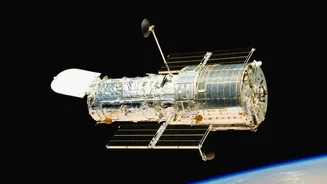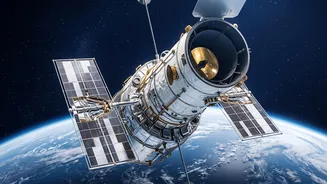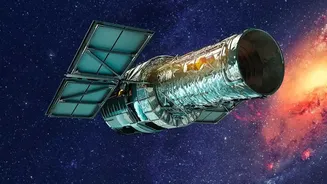




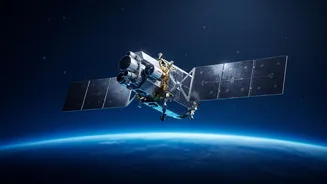
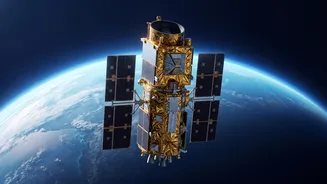

For over three decades, the Hubble Space Telescope has been humanity's eye on the cosmos. Now, that eye is slowly closing as its orbit decays. In a landmark move, NASA is turning to private companies for a rescue mission.
An Enduring Legacy at Risk
Since its launch in 1990, the
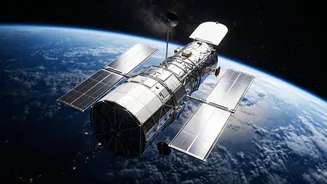
Hubble Space Telescope has revolutionized our understanding of the universe. It has helped scientists determine the age of the cosmos, discovered moons around Pluto, and provided definitive evidence of supermassive black holes at the center of galaxies. Its images, from the 'Pillars of Creation' to the deepest views of the early universe, have captivated the public and made it arguably the most productive scientific instrument ever built. But this invaluable asset is in slow-motion peril. Located in low-Earth orbit, it is subject to the planet's gravitational pull and faint atmospheric drag, causing it to gradually lose altitude.
Why Is Hubble Falling?
Hubble orbits about 550 kilometres above Earth, where the atmosphere is incredibly thin but not entirely absent. As the telescope speeds through the residual atmospheric particles, it experiences a tiny but constant amount of drag. This friction acts like a brake, slowing the telescope and causing its orbit to decay. Over many years, this has caused Hubble's altitude to drop. If nothing is done, NASA projects the telescope will re-enter the Earth's atmosphere sometime in the mid-2030s. Since the telescope is too large to fully burn up on re-entry, it would require a controlled de-orbit to ensure debris does not fall over inhabited areas. The last time Hubble received a boost was during a Space Shuttle servicing mission in 2002.
NASA's Open Invitation
Recognizing the risk, NASA has formally invited the commercial space industry to propose solutions. The agency released a Request for Information (RFI), a form of market research to gauge industry capabilities and potential costs. The request outlines three main possibilities: a 'reboost' mission to push Hubble into a higher, more stable orbit; a servicing mission to potentially upgrade its systems; or a mission to safely guide it to a controlled disposal at the end of its life. Companies have until November 30, 2026, to submit their ideas. This step formalizes a process that began with earlier, less formal studies, signalling that the agency is serious about exploring a commercial solution.
Who Could Answer the Call?
The most prominent name in the conversation is SpaceX. In 2022, the company, in partnership with the privately funded Polaris Program, signed an agreement with NASA to study the feasibility of using a Dragon spacecraft to rendezvous with and reboost Hubble. That study, which came at no cost to the government, highlighted the potential for either a robotic or crewed mission. While SpaceX is a strong contender, the RFI is open to all. Other companies specializing in satellite servicing and logistics, like Astroscale and Momentus, have also previously submitted concepts to NASA. The call for proposals is a clear sign that NASA is looking for innovative and cost_effective solutions, no matter the source.
A New Model for Space Operations
This initiative is more than just a repair job; it represents a profound shift in how space exploration is conducted. For decades, servicing missions were the exclusive domain of government agencies with massive budgets, like the Space Shuttle program that last visited Hubble in 2009. Today, the commercial space industry has matured, offering capabilities that were once the stuff of science fiction. As NASA's Nicky Fox, associate administrator for the Science Mission Directorate, noted, the commercial industry has evolved rapidly to offer new capabilities for in_space satellite capture and servicing. A successful commercial mission to save Hubble would not only extend its scientific life but also serve as a powerful proof_of_concept for a new economy of in_orbit servicing, from refueling satellites to clearing space debris.
The Road Ahead
The path forward is not without challenges. Any mission would need to be executed flawlessly, as a key requirement is to do no harm to the priceless telescope. The proposals will need to address complex technical questions of rendezvous and docking, as well as the crucial issue of funding, as NASA currently has no budget allocated for a Hubble reboost. The agency expects any potential mission would need to happen by 2032 to pre_empt the projected re_entry. Whether a robotic tug or a crewed spacecraft performs the task, the mission will be a high_stakes test of commercial prowess. A boost to the target altitude of $600$ kilometres could add another $25$ years to Hubble's life, ensuring its legendary gaze continues to uncover the secrets of any generation.