


A Panoramic View of the Universe
Imagine trying to assemble a million-piece jigsaw puzzle by looking at it through a drinking straw. That’s been the challenge of astronomy for decades. Telescopes like Hubble and James Webb provide incredibly deep, detailed views of small patches of the sky.
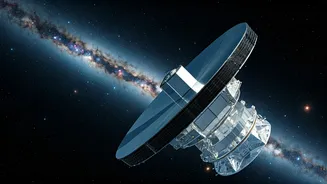
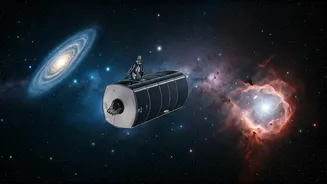
The Nancy Grace Roman Space Telescope, however, offers a breathtakingly different approach. While its primary mirror is the same size as Hubble's at 2.4 meters, its Wide Field Instrument will provide a field of view 100 to 200 times larger. [4, 5, 7] This means that in a single snapshot, Roman will capture a vast cosmic landscape with the same sharp resolution as Hubble. [4] This capability will allow it to map the sky up to 1,000 times faster than its legendary predecessor, transforming how scientists survey the universe. [22] Instead of just seeing individual trees, Roman will show us the entire forest.
Hunting the Ghosts of the Cosmos
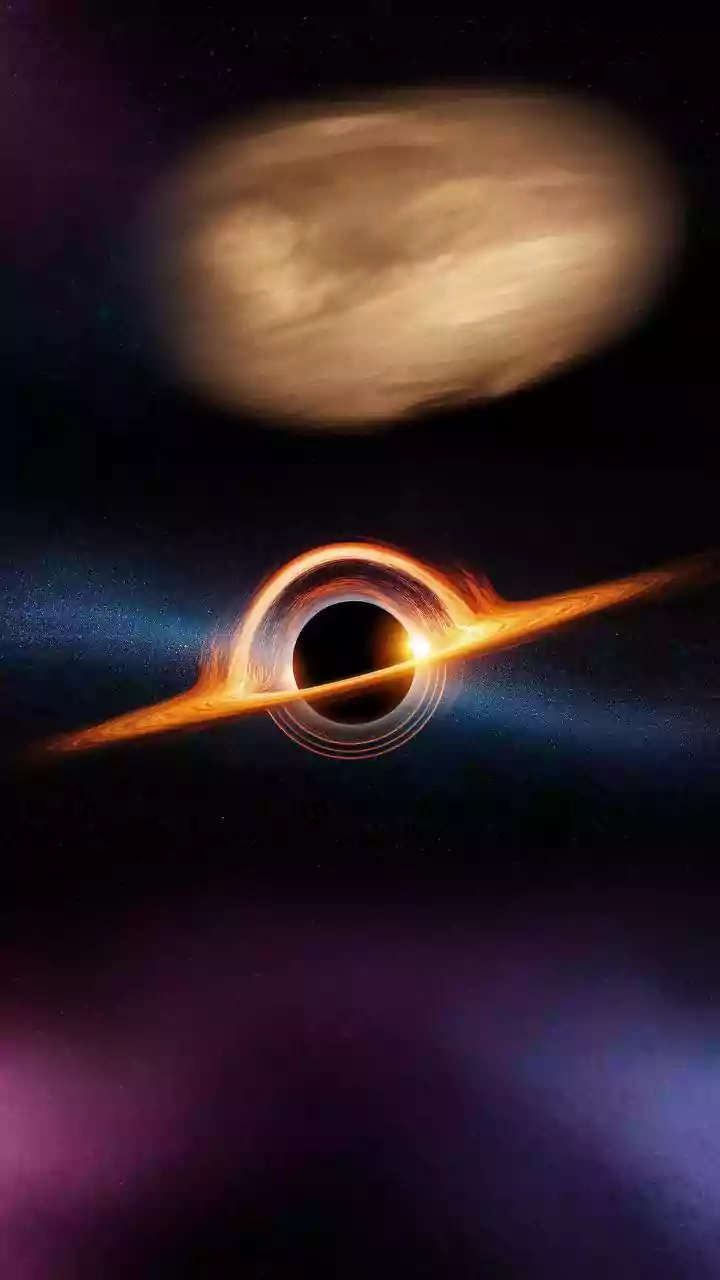
One of Roman’s primary missions is to tackle one of the most profound mysteries in all of science: dark energy. This enigmatic force is believed to make up about 68% of the universe and is responsible for its accelerating expansion. [9, 15] Yet, scientists know very little about its true nature. Roman will probe this mystery using three distinct methods: studying thousands of exploding stars called Type Ia supernovae, measuring the subtle warping of light by gravity (weak gravitational lensing), and mapping the large-scale clustering of galaxies to find the imprint of sound waves from the early universe (baryon acoustic oscillations). [1, 9, 15] By charting the expansion history of the universe and the growth of its largest structures, Roman will test whether the acceleration is caused by a new energy component or if it points to a breakdown in Einstein's theory of gravity on cosmic scales. [1, 9]
A Census of a Billion Stars
Beyond cosmology, Roman is poised to revolutionize the hunt for exoplanets—planets orbiting other stars. While missions like Kepler and TESS have been incredibly successful using the 'transit' method (watching for a star's light to dim as a planet passes in front), Roman will primarily use a different technique called gravitational microlensing. [5, 13] This phenomenon, predicted by Einstein, occurs when a foreground star and its planets pass in front of a more distant star, bending and magnifying its light like a cosmic lens. [5, 18] Microlensing is especially sensitive to planets farther from their stars, including worlds in the habitable zone and even free-floating 'rogue' planets not bound to any star. [3, 18] By repeatedly surveying the dense star fields toward the center of our galaxy, Roman is expected to discover thousands of new exoplanets, creating a statistical census of planetary systems and finding analogs to nearly every planet in our own solar system. [3, 13, 18]
A Powerful Partner, Not a Replacement
With the launch of another powerful space telescope, it's natural to ask how Roman fits in with Hubble and the James Webb Space Telescope (JWST). The answer is that they are designed as complementary observatories, each with unique strengths. [23] Webb is designed to peer deep into the infrared universe with extreme sensitivity, capturing the faintest, most distant light from the dawn of time, but over a narrow field of view. [19, 23] Roman, on the other hand, is a survey machine. [20] It will rapidly scan huge areas of the sky, identifying countless targets of interest—from rare exploding stars to intriguing planetary systems. [7, 23] Webb can then perform detailed follow-up observations on these discoveries. [21, 23] Think of Roman as the scout who maps the territory, finding all the points of interest, and Webb as the specialist who goes in for a close-up investigation.
The Road to Launch
Named after Nancy Grace Roman, NASA's first chief of astronomy and the 'Mother of Hubble,' the telescope's development has been a major undertaking. [5, 8] Recommended as the top priority for astronomy in 2010, the mission was formally approved in 2016. [1] After years of design, construction, and rigorous testing, the telescope arrived at NASA's Kennedy Space Center in Florida on June 21, 2026. [1, 10] Final preparations are now underway for its launch aboard a SpaceX Falcon Heavy rocket. NASA is officially targeting a launch date of August 30, 2026. [2, 10, 11] Once launched, it will travel to the second Sun-Earth Lagrange point (L2), a stable gravitational point about 1.5 million kilometers from Earth, where it will begin its five-year primary mission. [1, 4]