
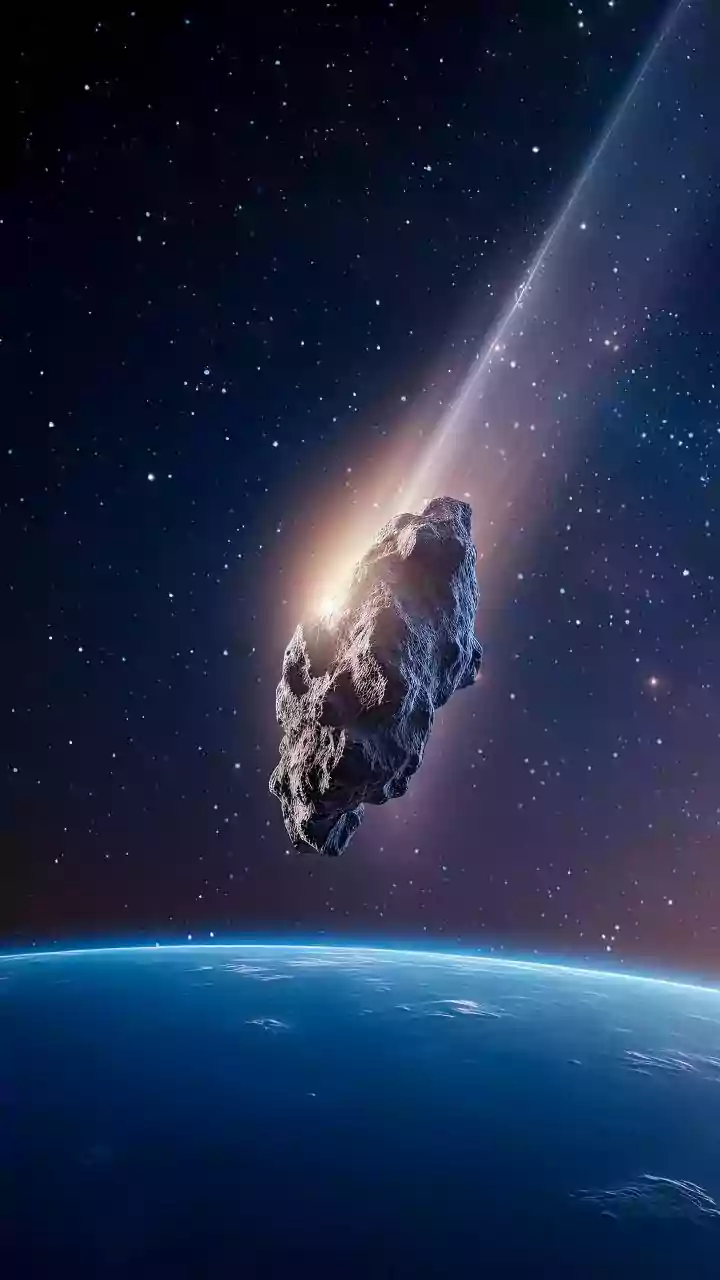


For a little while now, Earth has had a secret: a second moon. It's tiny, temporary, and you've likely never heard of it. But this fleeting companion, a small asteroid caught in our planet's gravitational embrace, is about to say goodbye.
Meet Our Temporary Guest
Astronomers have
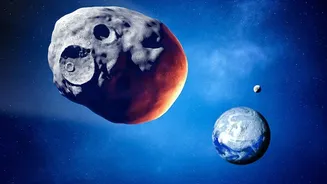
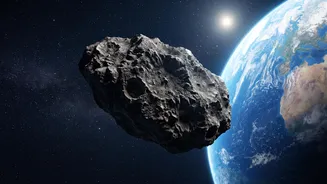
officially named our newest visitor 2026 QQ8. This small space rock, estimated to be about two metres (or six feet) in diameter, was captured by Earth's gravity back in April 2026. While the term 'mini-moon' isn't an official scientific designation, it's a fitting nickname for natural objects that are temporarily pulled into an orbit around our planet. This isn't the first time Earth has had a short-term satellite; objects like 2006 RH120 and 2020 CD3 have made temporary homes here before, orbiting for a year and three years respectively before drifting away. These celestial visitors are a normal, if rarely seen, part of our planet's journey through the solar system.
A Celestial Detective Story
Spotting an object as small and dim as 2026 QQ8 is no easy feat. It was first detected in August 2026 by Hungarian astronomer Krisztián Sárneczky at the Konkoly Observatory. Initially, it appeared to be just another near-Earth asteroid. For weeks, scientists weren't sure if they were looking at a natural object or a piece of defunct space junk, like an old satellite fragment. After careful observation, including analysing how the pressure from solar radiation affected its movement, astronomers confirmed it was a natural asteroid. The International Astronomical Union's Minor Planet Center, the body responsible for tracking such objects, officially gave it the designation 2026 QQ8 in late October 2026.
The Delicate Gravitational Dance
How does a planet like Earth capture a moon, even a temporary one? It's all about timing and proximity. When an asteroid's orbit around the Sun is very similar to Earth's, it can drift closer and closer to our planet. If it enters a region known as the Hill sphere—the area where Earth's gravity is the dominant force—at a sufficiently low velocity, it can be pulled into a temporary orbit. Think of it as a cosmic dance where the asteroid gets close enough to be gently spun around by Earth's gravitational pull for a few loops before continuing on its way. For 2026 QQ8, this capture happened in April 2026 when its path brought it just close enough to be snared.
A Fleeting Farewell
Our new companion's visit is nearing its end. Most sources predict that 2026 QQ8 will break free from Earth's gravity and leave our orbit in early December 2026, though some estimates suggest it could linger until January 2027. Once it escapes Earth's sphere of influence, it will resume its own independent orbit around the Sun. There's no need to worry about its departure; the asteroid poses no threat to our planet. Given its small size, even if its trajectory brought it into our atmosphere, it would harmlessly break up, at most creating a bright meteor. This won't be the last we see of 2026 QQ8, however. Its solar orbit is predicted to bring it back into Earth's vicinity for another notable approach in 2058.
Why Mini-Moons Matter
While 2026 QQ8 might be small, the study of mini-moons is a big deal for scientists. These objects are often difficult to detect because of their small size, distance, and speed, meaning many likely go unnoticed. In fact, experts at the Minor Planet Center estimate that, on average, there's probably at least one object like this orbiting Earth at any given time. Studying these temporarily captured objects provides a unique opportunity. They are essentially 'free samples' of asteroids delivered right to our cosmic doorstep. Analysing them can offer insights into the composition of asteroids, the dynamics of the early solar system, and the ongoing processes that shape our planetary neighbourhood. They are a constant reminder that the space around Earth is far more dynamic than it might seem.