







Decoding a Planet's Breath
An atmosphere is more than just a layer of gas; it's a planet’s fingerprint. It shapes the climate, shields the surface from harsh radiation, and contains the chemical clues to the world beneath. For astronomers, an exoplanet's atmosphere is a treasure
trove of information. The technique they use is called transit spectroscopy. When an exoplanet passes in front of its host star from our perspective, a tiny fraction of the star's light filters through the planet's atmosphere. Gases in that atmosphere absorb specific colours, or wavelengths, of light. By analysing the starlight that reaches our telescopes, scientists can see which colours are missing and deduce what chemicals are present, from water vapour to methane. It's like identifying a person by the unique shadow they cast.
The Telescope's Sharp Eye
This delicate work of cosmic detective-ry requires incredible precision, which is where instruments like the James Webb Space Telescope (JWST) come in. Positioned far from the distortion of Earth’s own atmosphere, JWST’s powerful mirrors and sensitive instruments are designed to capture the faint light from distant stars and dissect it. It can detect the minuscule dip in starlight caused by a transiting planet and, more importantly, identify the subtle chemical signatures left behind by its atmosphere. This technology has pushed the boundaries of exoplanet characterisation, allowing scientists to move beyond simply finding planets to beginning to truly understand them. What were once just blips in data are now becoming fully realised worlds with unique chemistries and climates.
A Gallery of Alien Skies
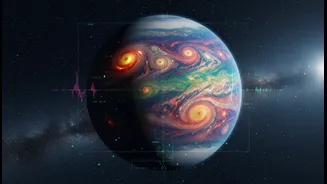
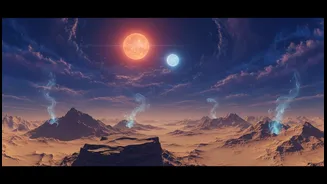
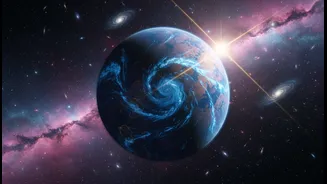
The results have been astonishing, revealing a zoo of planetary atmospheres. Scientists have studied “warm Jupiters” like WASP-80 b, where JWST detected both water vapour and, for the first time with such clarity, methane. This suggests a world with skies potentially similar to our own Uranus or Neptune. On the other end of the spectrum are ultra-hot rocky worlds like 55 Cancri e, a “super-Earth” so hot its surface may be a bubbling magma ocean. Evidence suggests it has a secondary atmosphere, continuously replenished by gases venting from the molten rock below. Then there are potential “Hycean” worlds like K2-18 b, which may have a hydrogen-rich atmosphere over a global water ocean. These discoveries show that planetary atmospheres are far more diverse than the ones in our own solar system.
From Atmosphere to Origin Story
Mapping an atmosphere doesn't just tell us what a planet is like now; it helps us understand its past. The chemical composition is a direct link to how and where the planet formed. For example, the ratio of different elements can indicate whether a planet formed close to its star in a hot environment, or farther out in the cold depths of its system before migrating inward. Understanding the presence or absence of certain molecules can help piece together a planet's entire life story. The detection of methane on WASP-80 b was significant because its expected presence had been a long-standing puzzle; finding it helps refine models of planetary chemistry. Each new atmospheric profile adds another piece to the grand puzzle of planet formation across the galaxy.
The Search for Life's Ingredients
Ultimately, the study of exoplanet atmospheres is tied to one of humanity’s oldest questions: are we alone? The same techniques used to find methane on a gas giant can be used to search for “biosignatures” on rocky, Earth-like worlds. These are gases, like oxygen and methane in a specific combination, that could indicate the presence of life. Very recent discoveries have provided the strongest evidence yet for an atmosphere on a rocky planet in its star's habitable zone, LHS 1140 b. While this planet is colder than Earth, the confirmation that it has an atmosphere makes it a prime target for future study. We are not looking at alien cities, but at the fundamental chemical ingredients that could make a world habitable. This new frontier of astronomy is getting us closer to knowing the answer.