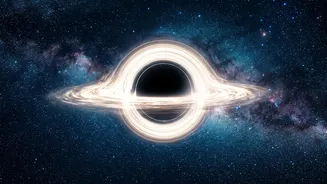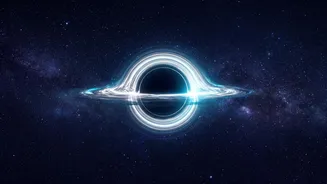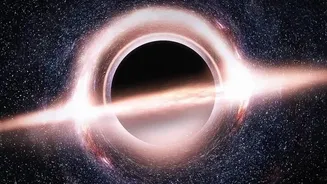



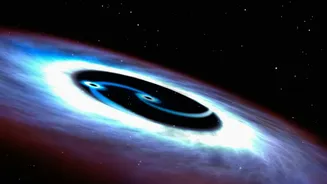
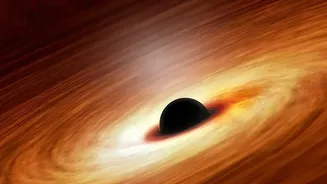
The Milky Way is hiding millions of secrets. Astronomers estimate our galaxy hosts up to 100 million black holes, yet we’ve only found about 70. A new project, however, is changing the game by asking for your help.
A Cosmic Needle in a Haystack
Finding black holes is notoriously difficult.
Their immense gravitational pull is so strong that not even light can escape, making them invisible to traditional telescopes. Scientists can spot them when they are actively 'feeding' on nearby gas and stars, which causes the material to heat up and emit powerful X-rays. But most black holes in our galaxy are thought to be dormant and not feeding, leaving them to wander the cosmos unseen. While models predict they should be everywhere, locating these quiet giants has been a monumental challenge. There are simply too many stars to watch and too much data to sift through for professional astronomers alone.
Unlocking the Power of Gravity
Fortunately, these invisible objects leave behind subtle clues. According to Einstein's theory of general relativity, a massive object's gravity can bend the fabric of spacetime, acting like a lens. The Black Hole Hunters project, led by researchers from the University of Southampton and the Open University, leverages a specific version of this called 'gravitational self-lensing'. This occurs when a black hole is in orbit with a star. If their alignment is just right from our perspective on Earth, the black hole will periodically pass in front of its companion. As it does, its gravity magnifies the star's light, causing it to appear briefly brighter to our telescopes. Spotting this repeating flicker is the key to finding a hidden black hole.
Enter the Citizen Scientist
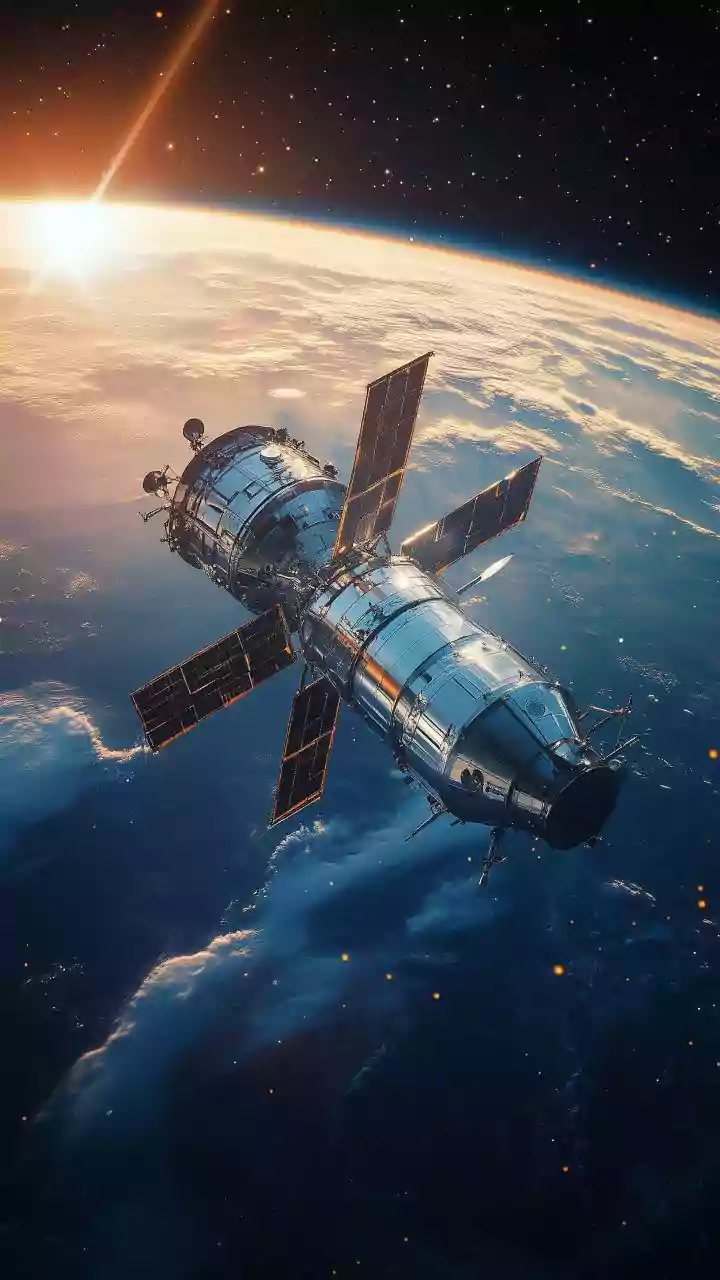
This is where the public comes in. The project, hosted on the citizen science platform Zooniverse, invites volunteers to become 'black hole hunters'. You don't need a degree in astrophysics to participate. An AI system first scans colossal amounts of data from NASA’s Transiting Exoplanet Survey Satellite (TESS), a space telescope that monitors the brightness of stars. This initial pass filters out millions of stars, flagging only the most promising candidates. These candidates are then presented to volunteers as simple graphs, or light curves, showing a star's brightness over time. The task is to look for the specific pattern that signals a potential self-lensing event.
The Human Advantage Over AI
While AI is powerful, it can be easily confused. Stellar flares, starspots, and the natural pulsations of some stars can create signals that mimic a black hole's signature, fooling an algorithm. The human brain, however, remains superior at certain types of pattern recognition. Volunteers can spot nuances and dismiss false positives that an automated system might miss. To ensure accuracy, the project employs the wisdom of the crowd. Each graph is shown to multiple volunteers, and their classifications are combined. When enough people flag the same candidate, it gets passed on to the science team for professional followup with more powerful telescopes. This collaborative filtering process dramatically narrows the search field, allowing astronomers to use precious telescope time much more efficiently.
Democratising Discovery
The Black Hole Hunters project does more than just accelerate the pace of discovery; it democratises it. It allows anyone with a computer and an internet connection to contribute to cutting edge research from their own home. Since its launch, nearly 23,000 volunteers have made millions of classifications, demonstrating a powerful public appetite for participating in science. This human machine partnership is a new frontier in astronomy. The classifications made by volunteers are not only helping to find black holes now but are also being used to train smarter machine learning models for the next phase of the search.