







2001: A Space Odyssey (1968)
More than half a century after its release, Stanley Kubrick’s masterpiece remains the benchmark for cerebral, visually ambitious science fiction. The film tells its story through powerful imagery rather than dialogue, from the iconic match cut that jumps
millions of years of evolution to the mesmerising and psychedelic Star Gate sequence. Kubrick obsessed over realism, pioneering special effects that were all captured “in-camera” without the use of computer graphics. The result is a crisp, tangible vision of the future that still feels breathtakingly modern. The intricate models of spacecraft, the vast rotating sets used to simulate gravity, and the elegant use of classical music to score scenes of silent space travel all combine to create an experience that is less a movie and more a piece of visual art. It influenced nearly every space film that followed and set a standard for how to portray the majestic, and often terrifying, beauty of the cosmos.
Gravity (2013)
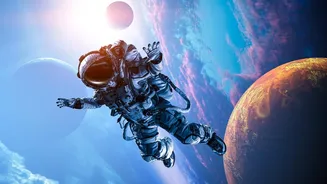
If ‘2001’ is about the philosophy of space, Alfonso Cuarón’s ‘Gravity’ is about the terrifying physics of it. The film is a masterclass in immersive, claustrophobic tension, placing the audience directly inside Sandra Bullock’s helmet as she tumbles through a storm of satellite debris. The visual effects team at Framestore built a groundbreaking “light box”—a cube lined with millions of LED lights—to project images of Earth and space onto the actors, creating realistic lighting and reflections that seamlessly blended with the CGI. The film is famous for its long, unbroken takes, which give the harrowing action a stunning sense of immediacy and realism. Watching it on a large screen, particularly in 3D, is a visceral experience that conveys the sheer vulnerability of being untethered in the void. It’s less about exploring new worlds and more about the desperate struggle for survival just a few hundred kilometres above our own.
Interstellar (2014)
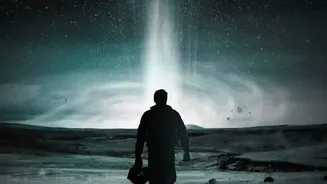
Christopher Nolan is a vocal champion of the IMAX format, and ‘Interstellar’ is arguably his greatest argument for it. The film, a sprawling epic about a last-ditch effort to save humanity, was shot with a combination of traditional and 70mm IMAX cameras, meaning the aspect ratio expands during key sequences, filling the entire screen with cosmic wonders. Nolan worked closely with theoretical physicist Kip Thorne to ensure the film's depiction of a wormhole and a black hole, named Gargantua, were as scientifically accurate as possible. The visual effects team even developed new rendering software to simulate how light would bend around such massive objects, resulting in visuals that were not only spectacular but also scientifically groundbreaking. From the silent, awe-inspiring journey through the wormhole to the sheer scale of the tidal waves on a distant planet, ‘Interstellar’ uses its immense canvas to ground mind-bending concepts in a powerful, emotional story.
The Martian (2015)
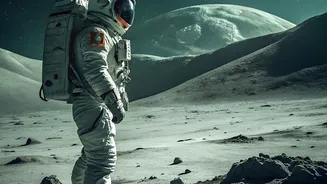
While many space films focus on the darkness of the void, Ridley Scott’s ‘The Martian’ finds incredible beauty in the stark landscapes of another planet. Based on the novel by Andy Weir, the film is a survival story grounded in scientific problem-solving. Cinematographer Dariusz Wolski filmed the Mars scenes in Jordan's Wadi Rum desert, using 3D cameras to capture the immense, ochre-coloured vistas that feel both alien and tangibly real. The film’s visual effects are subtle but powerful, seamlessly integrating shots of astronaut Mark Watney’s habitat and rovers into the breathtaking natural scenery. What makes it a big-screen spectacle is its ability to convey the scale of Watney's isolation. Seeing his tiny figure against the vast, empty plains of Mars underscores the sheer magnitude of his challenge and the stunning, desolate beauty of the Red Planet.
Dune (2021)
Though set thousands of years in the future, Denis Villeneuve’s adaptation of the classic sci-fi novel feels ancient, mythic, and monumentally vast. While much of the story takes place on the desert planet of Arrakis, the space travel sequences are a spectacle of brutalist, awe-inspiring design. Cinematographer Greig Fraser gives the film a naturalistic, grounded look, making the colossal spaceships feel like they have real weight and history. Unlike the sleek, clean ships of other sci-fi universes, the vessels in 'Dune' are immense, geometric structures that command the screen. The film’s sense of scale is its greatest visual asset. Whether it’s a tiny figure standing before a mountain-sized ship or the silent, intimidating arrival of the Spacing Guild, ‘Dune’ uses its visuals to communicate power, history, and the sheer insignificance of individuals in a sprawling galactic empire.