
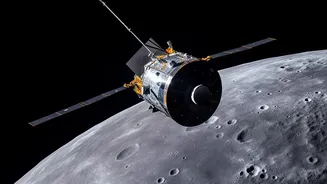
A Treasure Map for a Thirsty Moon
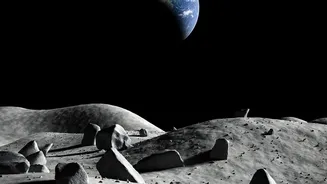
Recent breakthroughs have given scientists their most detailed look yet at the Moon’s most valuable resource: water. In early 2026, Chinese scientists released a high-resolution model detailing the stability of water ice at the lunar south pole, specifically
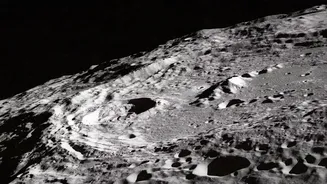
around the Shackleton Crater. This work, combined with new seismic surveying techniques demonstrated in mid-2026, allows researchers to not just guess where ice might be, but to map potential deposits buried deep beneath the surface. These maps are critical because lunar water isn't found in lakes or rivers. Instead, it's locked away as ice crystals mixed with lunar soil, or regolith, in permanently shadowed regions (PSRs) where sunlight has never reached. These frigid craters, with temperatures plunging hundreds of degrees below zero, are the reservoirs that could one day fuel humanity's expansion into the solar system.
From Frozen Dust to Rocket Fuel
The concept of using local resources in space is called in-situ resource utilization, or ISRU. For the Moon, water is the ultimate multi-purpose resource. The process is straightforward in principle: robotic miners would excavate the ice-rich regolith, heat it to release the water vapor, and then capture and purify it. Once you have liquid water (H₂O), a process called electrolysis uses electricity—generated by solar panels in nearby sunlit areas—to split the water molecules into their components: hydrogen and oxygen. This is a game-changer because liquid hydrogen and liquid oxygen (LOX) are two of the most powerful and commonly used rocket propellants. Essentially, the Moon itself provides the raw materials for the very fuel needed to leave it. Beyond fuel, that same oxygen can be used for breathable air in habitats, and the water can be used for drinking and growing food.
Beating the Tyranny of the Rocket Equation
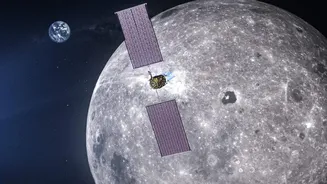
The biggest barrier to deep space travel has always been Earth’s gravity. Launching anything into space is incredibly expensive, and most of a rocket's mass is just the fuel needed to lift its own fuel. This is known as the 'tyranny of the rocket equation'. Launching fuel from Earth to a station in lunar orbit just to top up a spacecraft heading to Mars is wildly inefficient. A lunar refueling station flips this economic model on its head. Instead of hauling fuel up from Earth, a Mars-bound spacecraft could launch with just enough propellant to get to the Moon, refuel with locally-produced hydrogen and oxygen, and then continue its journey. This dramatically reduces the required launch mass from Earth, making missions cheaper, more ambitious, and more frequent. It opens the door to a sustainable cislunar (Earth-Moon) economy.
The Next Steps: Proving the Technology
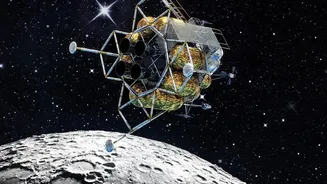
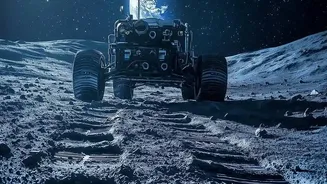
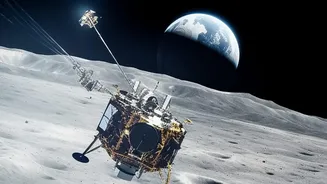
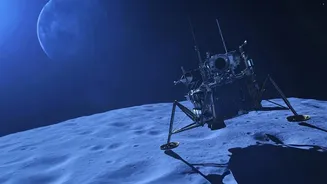
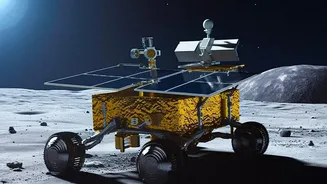
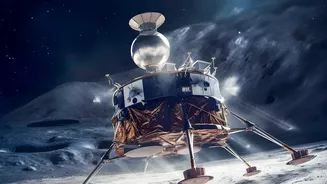
While the science is promising, significant engineering challenges remain. Missions are now focused on proving that ISRU is not just possible, but practical. NASA's VIPER rover, now slated for a late 2027 landing via a Blue Origin lander, is a crucial next step. This golf-cart-sized robot will venture into the Moon's dark craters to drill for and analyze water ice, creating the first ground-truth maps of these resources. China's Chang'e-7 mission, planned for the south pole, also aims to perform in-situ analysis of water ice. Meanwhile, projects like NASA's CryoFILL are testing the technologies needed to liquefy and store cryogenic propellants like oxygen on the lunar surface. These missions are designed to bridge the gap from laboratory concepts to a functioning lunar outpost.
The Gateway to Mars and Beyond
A lunar refueling station isn't just about making trips around the Moon easier; it's the critical piece of infrastructure needed for humanity to become a multi-planetary species. The Moon would become a true gateway to the solar system. With a ready supply of fuel and water in a shallow gravity well, the Moon becomes the logical staging point for crewed missions to Mars and the asteroid belt. The ability to refuel in space unlocks larger spacecraft, longer missions, and a more robust deep-space supply chain. The new lunar ice maps are more than just scientific curiosities; they are the blueprints for the next era of exploration, laying the foundation for a permanent human presence beyond Earth.