



First, What Is a Quasar?
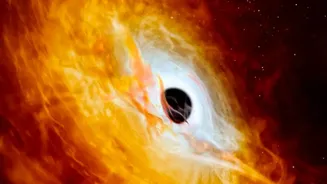
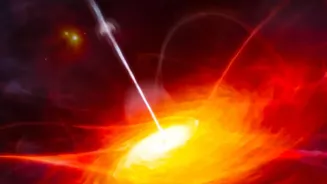
Imagine an object so bright it can outshine its entire galaxy, which itself contains hundreds of billions of stars. That’s a quasar. Short for 'quasi-stellar radio source', the name comes from their discovery in the 1950s when they appeared as star-like
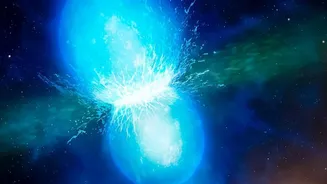
points of light but were powerful sources of radio waves. We now know that a quasar is not a star, but an extremely luminous active galactic nucleus (AGN). At the heart of a quasar is a supermassive black hole, millions or even billions of times the mass of our sun. As this black hole voraciously feeds on surrounding gas and dust, the material forms a superheated accretion disk around it. The immense friction and gravitational forces cause this disk to glow with unimaginable intensity, creating the beacon we see as a quasar.
A Pair of Giants at the Dawn of Time
Recently, astronomers using data from the JWST’s Aether survey, a program designed to census objects in the early universe, spotted something unusual. They found not one, but two quasars sitting remarkably close to each other. Designated J1602+4228AB, and given the Hawaiian name Nāpōwawāʻenakaulua, this system is seen as it was just 900 million years after the Big Bang. This places the discovery firmly in an era known as 'cosmic dawn', when the first stars and galaxies were just beginning to form. The two supermassive black holes powering these quasars are separated by only 18,100 light-years—a small distance in cosmic terms, roughly one-fifth the diameter of our own Milky Way galaxy.
Why This Discovery Is a Puzzle
Finding a single quasar from this early epoch is a major event. Finding a pair this close together is astounding and poses a significant challenge to current cosmological models. The black holes are already monstrously large for their age: one is estimated to contain 1.5 billion times the mass of the Sun, and its companion holds about 400 million solar masses. According to our leading theories, building up black holes of this size should take far longer than 900 million years. As researcher Silvia Onorato of NSF's NOIRLab noted, there is no definitive theoretical explanation for how even one of these giant quasars can exist so early, let alone two. The discovery of Nāpōwawāʻenakaulua is only the third known quasar pair from the cosmic dawn, and it is by far the most massive and compact.
A Laboratory for Galaxy Formation
So, how could this happen? The leading hypothesis is that this quasar pair resides within an unusually dense pocket of the early universe. Such an environment, a kind of cosmic metropolis under construction, would be rich with gas and undergoing frequent galaxy mergers. These conditions would provide a feast for black holes, allowing them to grow much more rapidly than models would otherwise predict. The system essentially acts as a unique laboratory for studying how the first massive galaxies and their central black holes grew together through direct interactions. The quasars are lighting up a massive structure in the process of formation, giving scientists a rare snapshot of cosmic assembly in action.
The Power of Webb and Gemini
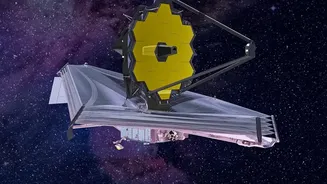
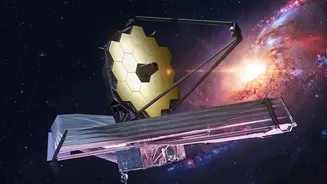
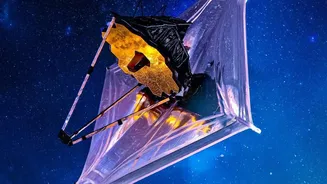
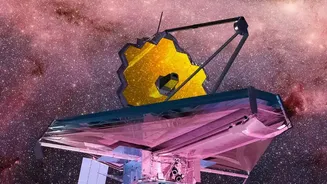
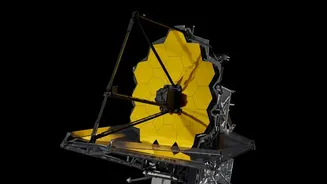
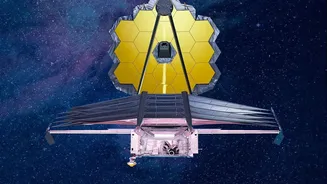
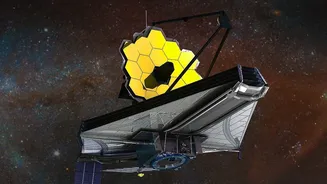
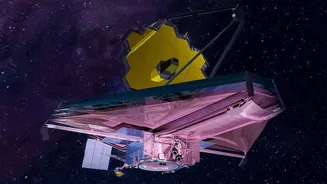
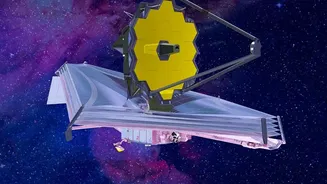
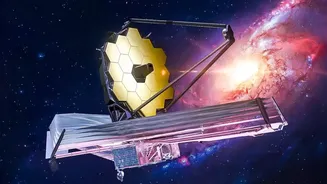
This discovery would not have been possible without the advanced technology of the JWST. Its powerful near-infrared instruments were able to first identify the quasar and its faint companion from the Aether survey data. To confirm the finding, astronomers used the Gemini North telescope in Hawai'i, whose instruments helped clearly resolve the two distinct objects and analyze their properties. Light from the early universe is stretched to longer, redder wavelengths by cosmic expansion, a phenomenon known as redshift. JWST is specifically designed to capture this infrared light, allowing it to peer back to the universe's infancy in unprecedented detail, a feat impossible for older telescopes focused on visible light.