



The Ultimate Ejection Seat
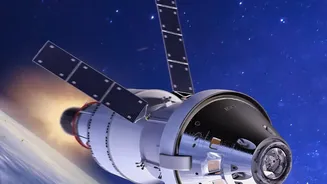
Think of the Crew Escape System (CES) as the most sophisticated ejection seat ever built. It's a dedicated safety mechanism designed for one purpose: to pull the crew module—the capsule carrying the astronauts—away from a failing rocket in milliseconds.
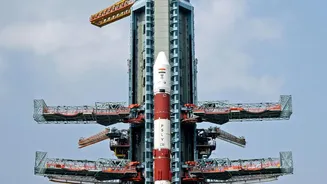
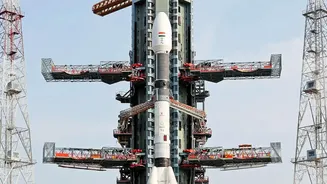
This system sits atop the entire rocket stack, a cone-shaped structure packed with powerful, quick-acting solid-fuel motors. If the onboard computers detect a critical problem, like a loss of thrust or a dangerous deviation from the flight path, the CES is programmed to automatically activate and save the crew.
Scenario 1: Trouble on the Launchpad
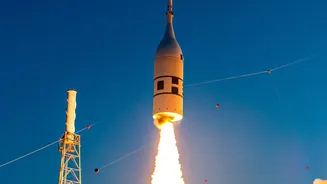
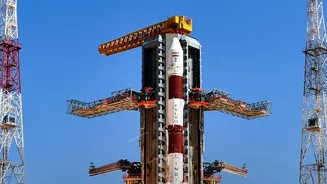
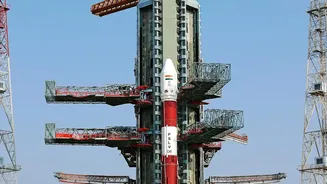
An emergency can happen even before liftoff. If a critical issue is detected while the rocket is still on the ground—a situation known as a 'pad abort'—the CES springs into action. In July 2018, ISRO successfully conducted a Pad Abort Test to validate this exact scenario. In such an event, the escape motors fire with immense force, lifting the crew module and accelerating it away from the launchpad. The system is designed to carry the astronauts to a safe altitude and distance before deploying parachutes for a gentle landing, far from the potential danger of an exploding rocket on the ground.
Scenario 2: Failure During Ascent
The ascent through the atmosphere is another critical phase. The rocket is fighting gravity and experiencing immense aerodynamic pressure, especially as it approaches and breaks the sound barrier (a phase known as 'transonic'). ISRO has extensively tested for this with missions like the Test Vehicle Abort Mission-1 (TV-D1). This test simulated an in-flight emergency, triggering the abort sequence at an altitude of about 17 km. The CES motors fired, powerfully pulling the crew module away from the test vehicle. The system is engineered to provide an acceleration burst strong enough to outrun any potential explosion from the main rocket.
The Escape Sequence: A Precise Ballet
When an abort is triggered, a precise sequence of events unfolds in seconds. First, pyrotechnic devices sever the connections holding the crew module to the rocket. Simultaneously, the high-burn-rate solid motors in the escape system ignite, yanking the module up and away. These motors are angled to steer the capsule on a safe trajectory. Once the escape motors burn out and the module has reached a safe altitude, the escape system itself is jettisoned. The crew module then reorients itself for descent. A series of parachutes—starting with smaller drogue chutes and followed by large main parachutes—deploy to slow the capsule down for a soft splashdown in the sea. Recovery teams from the Indian Navy are then tasked with retrieving the astronauts and the module.
Testing for Perfection
Confidence in such a life-or-death system comes only from relentless testing. ISRO has adopted a strategy of demonstrating Technology Preparedness Levels through a series of precursor missions. From the Pad Abort Test in 2018 to the high-altitude TV-D1 mission, each test validates a different aspect of the escape system under various conditions. Even an automated hold during one launch attempt, which postponed the launch, was seen as a success, as it proved the onboard computers were correctly identifying anomalies. These rigorous tests ensure every component, from the motors to the parachutes and the recovery procedures, functions flawlessly when it matters most, making the system robust and reliable for India's first human spaceflight.