


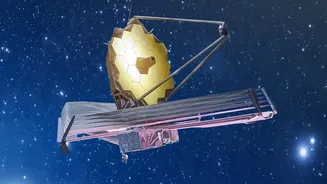
Meet the Universe's New Detective
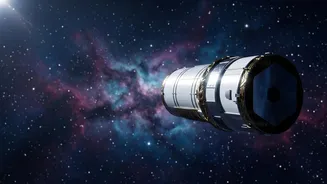
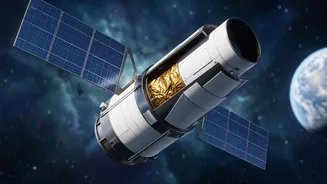
First, it's important to understand what the Roman Space Telescope is. Named after NASA's pioneering first chief of astronomy, Nancy Grace Roman, this observatory is designed to be a cosmic detective on a grand scale. Its primary mission is to tackle
two of the biggest mysteries in astrophysics: dark energy and exoplanets. With a field of view 100 to 200 times larger than Hubble's, Roman will create vast, panoramic maps of the universe, capturing data from billions of galaxies and thousands of new planets. It’s a flagship mission built to survey huge swathes of the sky, seeking to understand the force causing the universe's expansion to accelerate and to complete a census of planets in our galaxy.
What is a Lagrange Point?
Roman’s destination, the Sun-Earth L2 Lagrange point, isn't a place you can see. It's a concept of physics, first described by mathematician Joseph-Louis Lagrange in the 18th century. In any two-body system, like the Sun and Earth, there are five unique points where the gravitational pulls of the two large objects and the orbital motion of a third, smaller object are perfectly balanced. Think of it as a gravitational sweet spot. L1, L2, and L3 lie on a straight line with the Sun and Earth, while L4 and L5 form triangles. L2 is located about 1.5 million kilometers (930,000 miles) from Earth, directly on the opposite side from the Sun. An object placed here can keep pace with Earth's year-long journey around the Sun, essentially hovering in the same relative position.
An Uninterrupted, Chilling View
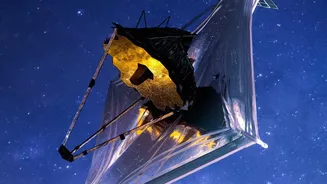
For an infrared telescope like Roman, heat is the enemy. The telescope's own warmth can interfere with its ability to detect faint heat signals from distant galaxies. The L2 point offers a brilliant solution. From this vantage point, the Sun, Earth, and Moon are all in the same direction, allowing the telescope to use a single, large sunshield to block their heat and light simultaneously. This keeps the sensitive instruments perpetually cold and shaded, operating in a stable thermal environment. Unlike the Hubble Telescope, which orbits Earth and is regularly eclipsed or blinded, a telescope at L2 has a continuous, unobstructed view of the deep cosmos, allowing for long, uninterrupted observations.
Fuel Efficiency and Mission Longevity
While L2 is a point of gravitational equilibrium, it's technically an unstable one, like balancing a pencil on its tip. A spacecraft doesn’t sit perfectly still at L2 but instead enters a wide “hal o orbit” around the point. The benefit is that it requires very little fuel to maintain this orbit. The telescope will only need to perform small, occasional thruster burns to correct its course and stay in the L2 region. This fuel efficiency is critical, as it directly translates to a longer mission life. Roman carries enough fuel for its five-year primary mission and a potential five-year extension, maximizing the scientific return on this significant investment.
Prime Real Estate for Astronomy
NASA's choice of L2 for Roman isn't a new experiment; it’s a proven strategy. This cosmic neighborhood has become prime real estate for deep space observatories. It has been home to past missions like the WMAP and Planck telescopes, which mapped the afterglow of the Big Bang. Today, Roman is joining an elite club at L2 that includes the James Webb Space Telescope and the European Space Agency's Euclid mission. The area is vast enough for these observatories to operate in their own distinct orbits without interfering with one another. Sending Roman to this well-established location leverages decades of operational knowledge, ensuring the telescope has the best possible environment to carry out its groundbreaking science.