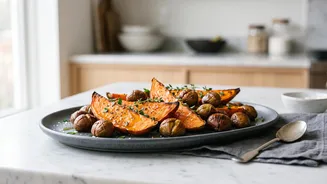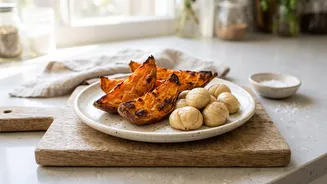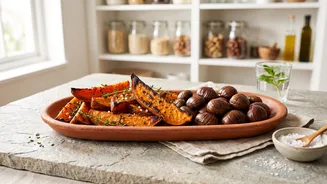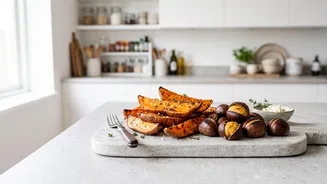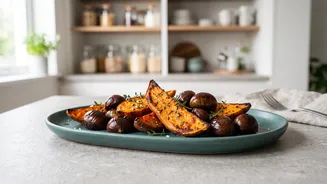



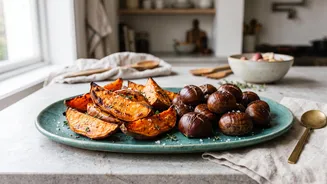
As the air gets cooler, two seasonal favourites appear in our markets: the humble sweet potato and the festive chestnut. Both are delicious, but which one is the smarter nutritional choice? Let's break down the facts beyond the hype.
The Calorie Question
On the surface, the calorie
comparison seems straightforward. Raw sweet potato contains significantly fewer calories than roasted chestnuts—around 86 calories per 100g compared to about 245 for the nut. This makes sweet potato seem like the obvious winner for weight management. However, this doesn't tell the whole story. The way you cook them matters immensely. Boiling or steaming sweet potatoes keeps their calorie count low, whereas roasting can concentrate their sugars and slightly increase calorie density as water evaporates. Chestnuts, while higher in calories, are actually one of the lowest-calorie nuts available, with much less fat than almonds or walnuts. So, while sweet potatoes are lower in calories overall, a small handful of chestnuts can be a satisfying, relatively low-calorie snack compared to other nuts.
A Look at Carbohydrates and Fibre
Both foods are rich in complex carbohydrates, which provide sustained energy. However, chestnuts pack a heavier carb punch, with about 53g per 100g, while sweet potatoes have around 20g. Interestingly, chestnuts also have more dietary fibre, with roughly 5.1g per 100g compared to 3g in sweet potatoes. This high fibre content in both foods helps support digestive health and can aid in blood sugar management. When it comes to blood sugar, the glycemic index (GI) is a key factor. Chestnuts have a low GI of 54. The GI of sweet potatoes varies dramatically with preparation; boiling them results in a low-to-medium GI (around 46-61), but baking can cause it to spike as high as 94. For stable energy, boiled sweet potatoes and roasted chestnuts are both excellent choices.
The Vitamin and Mineral Profile
This is where the two diverge significantly, and where your personal health goals come into play. Sweet potatoes are nutritional powerhouses when it comes to Vitamin A. Just one medium sweet potato can provide over 100% of your daily required intake of Vitamin A in the form of beta-carotene, which is crucial for vision, immune function, and skin health. Chestnuts, on the other hand, stand out for being one of the only nuts to contain a significant amount of Vitamin C, a powerful antioxidant. A 100g serving of chestnuts can provide a substantial portion of your daily Vitamin C needs. Chestnuts are also richer in B vitamins and minerals like copper and manganese, while both are good sources of potassium, which is important for heart health.
Context is Everything: Preparation and Portions
The phrase 'reading calories per serving' is crucial. A 'serving' isn't a fixed measure. It’s easy to eat a large baked sweet potato loaded with toppings, pushing its calorie and sugar load far beyond that of a small bowl of roasted chestnuts. In India, sweet potato is often enjoyed as 'shakarkandi ki chaat', a street-food delicacy where the tuber is roasted, cubed, and mixed with spices and chutneys. This can be a healthy snack. Chestnuts are less common in mainstream Indian cuisine but are sometimes used in pulaos or stuffings, similar to how jackfruit seeds are used. The key is mindfulness. Are you having a few roasted chestnuts as a snack, or are you eating a large dessert made with chestnut puree and sugar? Is your sweet potato simply boiled, or is it fried and sweetened? The final health impact depends entirely on these choices.
The Verdict: Which Should You Choose?
There is no single winner in the battle between sweet potatoes and chestnuts. The best choice depends entirely on your dietary needs. If you are looking to boost your Vitamin A intake and want a lower-calorie, high-fibre carbohydrate, boiled sweet potato is an excellent option. If you need a gluten free food, a good dose of Vitamin C and B vitamins, or a heart healthy snack that is lower in fat than other nuts, chestnuts are a fantastic choice. Neither is inherently 'better' or 'worse'. Both offer unique nutritional benefits and can be part of a healthy, balanced diet, especially during the winter months when they are in season. The goal is not to eliminate one, but to understand how to incorporate both wisely.