



Why Venus? A Tale of Two Planets
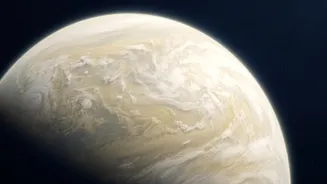
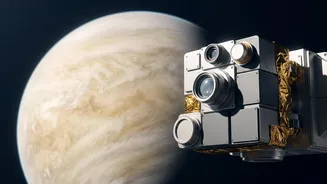
Often called Earth's twin due to its similar size and structure, Venus is a world of extremes. Its atmosphere is over 96% carbon dioxide, creating a runaway greenhouse effect that pushes surface temperatures to a scorching 467°C, hot enough to melt lead.
The atmospheric pressure is more than 90 times that of Earth's, and the planet is shrouded in thick clouds of sulfuric acid. Scientists believe Venus may have once been habitable, possibly with liquid water oceans, but something went catastrophically wrong. By studying its atmospheric chemistry, ISRO's Shukrayaan mission aims to understand how a planet so similar to our own became such an inhospitable wasteland, offering a crucial cautionary tale for Earth's own climate evolution.
The Core Objective: A Chemical Deep-Dive
The primary goal of Shukrayaan is to conduct a detailed investigation into the composition and dynamics of the Venusian atmosphere. The mission will focus on the complex chemical processes occurring from the cloud tops down to the surface. This includes understanding how the thick sulfuric acid clouds are formed and sustained through the interaction of sulfur dioxide, water vapour, and sunlight. The spacecraft will also study the mysterious 'super-rotation' of Venus's atmosphere, which whips around the planet in just four Earth days. One of the key investigations will involve the search for certain gases like phosphine, a potential biomarker whose fleeting detection has sparked intense debate about the possibility of microbial life floating in the planet's more temperate upper cloud layers.
A Toolkit for a Toxic World
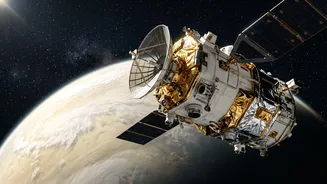
To achieve its ambitious goals, Shukrayaan will carry a suite of advanced scientific instruments, some developed with international partners from France, Sweden, Germany, and Russia. The Venus Infrared Atmospheric Gases Linker (VIRAL) instrument, a collaboration with France and Russia, will analyze the composition of the atmosphere, looking for trace gases. Another key payload, the Venusian Neutrals Analyzer (VNA) developed with Sweden, will study how charged particles from the sun interact with the planet's upper atmosphere. Spectrometers observing in infrared and ultraviolet wavelengths will provide further details on atmospheric composition and dynamics, helping to create a comprehensive picture of the chemical processes at play.
Peering Beneath the Clouds
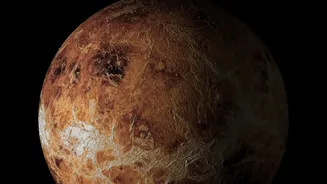
While atmospheric study is central, understanding the chemical dynamics requires looking at the whole system, including the planet's surface. Shukrayaan's flagship instrument is a high-resolution Synthetic Aperture Radar (SAR), which can penetrate the dense clouds to map the surface in unprecedented detail. This will be a significant upgrade from NASA's Magellan mission in the 1990s, allowing scientists to search for signs of active volcanism. Active volcanoes would be a major source of atmospheric gases like sulfur dioxide, directly linking geology to the atmosphere's chemistry. For the first time ever, a ground-penetrating radar will also be used to study the shallow subsurface of Venus, offering clues about its geological history and evolution.
ISRO's Interplanetary Leap
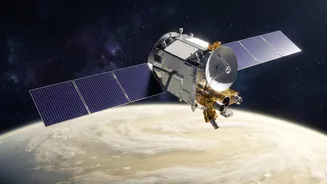
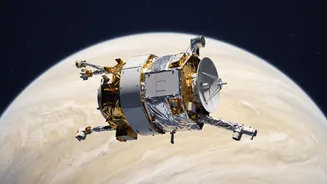
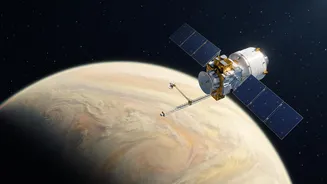
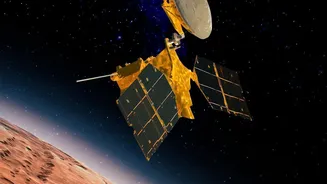
Scheduled for a 2028 launch aboard India's powerful LVM-3 rocket, Shukrayaan represents a major step forward for ISRO's planetary science program. Following the successes of Chandrayaan and Mangalyaan, this mission solidifies India's position as a key player in global space exploration. The orbiter is planned to operate for over four years, gathering invaluable data that will complement missions from NASA and the European Space Agency. After a journey of about 112 days, the spacecraft will enter a highly elliptical orbit, allowing it to study Venus from various altitudes. This long-duration study is crucial for understanding the planet's weather patterns, atmospheric cycles, and long-term chemical changes.