
A Planet for All Seasons
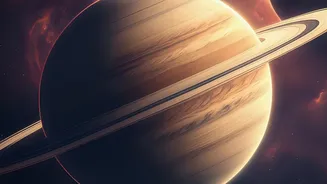
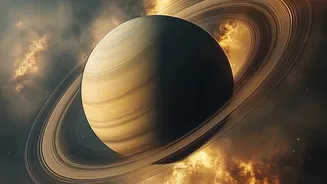
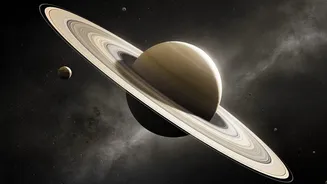
Like Earth, Saturn has seasons, but on a much grander scale. A single Saturnian year lasts for about 29.5 Earth years, meaning each season stretches for more than seven of our years. The latest observations are part of a long-term project called the Outer
Planet Atmospheres Legacy (OPAL) program. For over a decade, Hubble has been annually checking in on our solar system's gas giants to monitor their weather patterns, storms, and atmospheric shifts over time. This consistent, long-term view is crucial for understanding the slow, dramatic seasonal changes that unfold on Saturn.
What the New Images Reveal
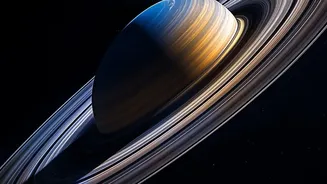
The latest images, captured in August 2024, show Saturn as it moves from its northern summer toward its 2025 equinox. By observing the planet in infrared light, astronomers can peer through the upper layers of haze and see details within the cloud bands. These false-colour images reveal subtle variations in the altitude and composition of the clouds. Blue colours typically indicate a clearer atmosphere, while greens and yellows suggest a thicker haze above the main cloud decks. By tracking these changes year after year, scientists can build a comprehensive weather map of a world hundreds of millions of miles away.
A Tale of Two Telescopes
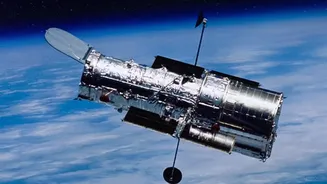
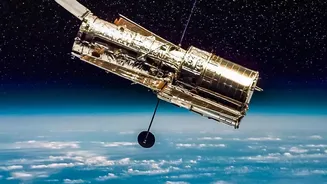
While the headline focuses on Hubble, the latest round of Saturn observations also involved the James Webb Space Telescope (JWST), which captured its own images a few months after Hubble in late 2024. The two telescopes have complementary capabilities. Hubble observes in visible and ultraviolet light, showing the planet much as our eyes would see it, with subtle colour variations. JWST, on the other hand, is a master of infrared light, allowing it to see different depths in the atmosphere, picking up on heat signatures from clouds and chemicals that are invisible to Hubble. Together, they allow scientists to peel back the layers of Saturn's atmosphere like an onion, creating a three-dimensional picture of its complex weather systems.
Storms, Waves, and a Disappearing Hexagon
The combined power of Hubble and Webb has highlighted several fascinating atmospheric features. JWST's view revealed a long-lived jet stream known as the "ribbon wave" and the lingering remnants of the "Great Springtime Storm" from over a decade ago. Both telescopes also caught a glimpse of the famous hexagon-shaped jet stream at Saturn's north pole. However, scientists note these might be the last clear views of the hexagon until the 2040s. As Saturn's northern pole tilts away from the sun and enters a 15-year winter, it will be shrouded in darkness, hiding one of the solar system's most intriguing weather patterns from our view.
Why These Observations Matter
Studying the weather on other planets helps us understand the fundamental principles of fluid dynamics and atmospheric physics under conditions very different from our own. Saturn acts as a giant natural laboratory for these processes. The long-term monitoring by Hubble's OPAL program provides a critical baseline of data, tracking how the planet's massive storms form and fade and how its atmospheric bands shift with the seasons. The addition of JWST's powerful infrared eyes builds on the legacy of both Hubble and the Cassini mission, which orbited Saturn from 2004 to 2017. This continuous observation across different wavelengths gives us an unprecedented ability to model and understand the dynamic forces shaping the giant planets in our solar system.