




A Sudden Burst of Light
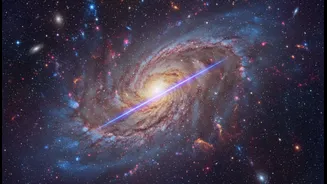
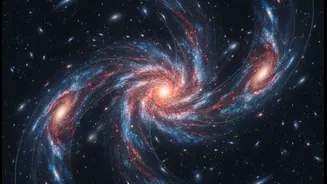
For years, the galaxy known as SDSS1335+0728 was just another quiet spot in the vastness of space. Located in the Virgo constellation, it showed no signs of unusual activity. Then, in December 2019, that all changed. Automated sky surveys, which constantly
scan the heavens for changes, flagged a dramatic and sudden brightening at the galaxy's core. What was once a calm, unremarkable galaxy had suddenly started to shine with unprecedented intensity, catching the global astronomical community completely by surprise.
The Awakening of a Giant
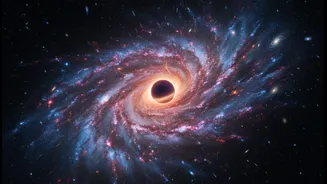
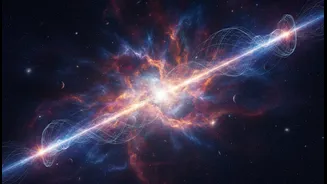
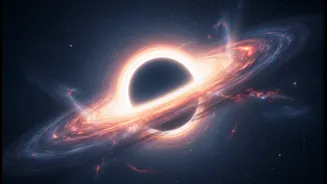
So, what does it mean for a galaxy's core to 'wake up'? At the heart of most large galaxies, including our own Milky Way, lies a supermassive black hole—a gravitational behemoth millions or billions of times the mass of our sun. Most are 'sleeping' or dormant, not actively consuming large amounts of matter. However, when a large supply of gas or dust gets too close, the black hole begins to feast. This process of consumption, called accretion, releases immense amounts of energy, causing the region around the black hole to blaze with light across the entire electromagnetic spectrum. This energized core is known as an Active Galactic Nucleus (AGN). In the case of SDSS1335+0728, astronomers saw its brightness double in the mid-infrared, quadruple in ultraviolet, and increase tenfold in X-rays, confirming a massive new flow of matter into its central engine.
A Truly Unprecedented View
Astronomers have seen active galaxies before, but what makes this event historic is that it’s the first time they have ever witnessed the activation process happen in real time. Other cosmic events, like a supernova (a star exploding) or a standard Tidal Disruption Event (TDE), where a star is shredded by a black hole, can cause a galaxy to light up. But these events are relatively brief, lasting for a few hundred days at most. The brightening of SDSS1335+0728 has been going on for over four years and is still increasing, which points to a much larger, more fundamental change. It’s like the difference between watching a flash of lightning and watching the sun rise. One is a fleeting event; the other is the start of a whole new state of being.
A Cosmic Whodunit
The ongoing investigation has two main theories. The first, and most exciting, is that we are witnessing the genuine birth of an Active Galactic Nucleus. The black hole may have captured a massive cloud of interstellar gas and is now settling in for a long meal that could last for thousands or millions of years. The other possibility is that this is a highly unusual and extremely long TDE. Perhaps a very large star was torn apart in a unique way, creating a slow-burning flare that defies typical models. While scientists are still gathering data, the sheer duration of the event makes the AGN activation theory a stronger candidate. Continuous observation is the only way to be sure.
Why This Awakening Matters
This event is more than just a cosmic light show; it’s a unique laboratory for understanding some of the biggest questions in astrophysics. Observing how a black hole turns on provides direct insight into how these giants grow and how they shape the galaxies around them. The energy blasted out by an AGN can influence star formation and the overall evolution of its host galaxy. Some scientists have even noted that a similar process could, in theory, happen to Sagittarius A*, the supermassive black hole at the centre of our own Milky Way, though the probability is considered low. By studying SDSS1335+0728, we get a front-row seat to a fundamental process that has shaped the universe as we know it, helping to refine our models of the cosmos.