




A New Window to the Cosmos
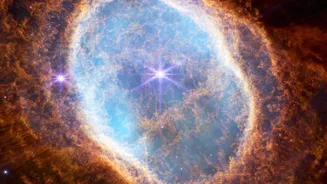
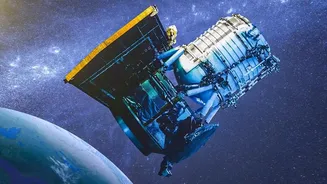
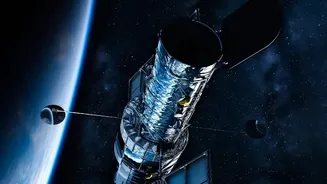
Launched as a successor to the Hubble Space Telescope, the JWST is a technological marvel designed to see the universe in infrared light. This capability is crucial for studying exoplanets—planets orbiting other stars. One of its primary methods is called
transmission spectroscopy. When a planet passes in front of its star from our perspective, a tiny fraction of the starlight filters through the planet's atmosphere. By capturing this light, Webb can detect the chemical fingerprints of gases present, essentially 'reading' the atmospheric composition from light-years away. This has opened up a new frontier in astronomy, moving us from simply detecting exoplanets to truly characterizing them.
The Curious Case of 55 Cancri e
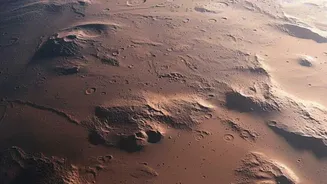
One of the most exciting recent subjects is 55 Cancri e, a “super-Earth” about 41 light-years away. Orbiting its star in a blistering 18 hours, its surface is thought to be a molten ocean of magma. Conventional wisdom suggested that a rocky planet so close to its star would have its atmosphere completely stripped away. However, JWST data has provided the best evidence to date that 55 Cancri e does, in fact, possess a substantial atmosphere. Researchers believe this atmosphere is not primordial but 'secondary,' constantly being replenished by gases bubbling out from the magma ocean below. This finding challenges long-held assumptions about where atmospheres can and cannot exist.
What the Data Reveals
Initial observations from Webb's instruments showed that the planet's dayside was cooler than expected if it were just bare rock, hinting that an atmosphere was redistributing heat. Analysis of the light spectrum suggests the presence of gases like carbon monoxide and possibly carbon dioxide. More recent findings from July 2026 even point to a surprisingly hydrogen-rich atmosphere, which is contrary to models that predicted gases heavier in carbon and oxygen. This dynamic, hellish world seems to be shaped by intense volcanic outgassing from its molten interior, creating a complex and evolving environment that scientists are only just beginning to understand. The data suggests the planet’s interior chemistry may favour hydrogen over oxygen, helping to explain the unexpected atmospheric composition.
Rethinking Planetary Evolution
The confirmation of a stable, secondary atmosphere on a world like 55 Cancri e has profound implications. It suggests that planetary atmospheres might be more resilient and common than previously believed, even under extreme conditions. If a planet being blasted by stellar radiation while covered in lava can sustain an atmosphere, it broadens the possibilities for countless other rocky worlds throughout the galaxy. This discovery provides a crucial, real-world laboratory for testing theories of planetary formation and evolution, helping scientists refine their models for what makes a planet lose or retain its gaseous envelope over billions of years.
The Stepping Stone to Finding Life
While 55 Cancri e is far too hot to be habitable, the techniques used to study it are a vital dress rehearsal for the ultimate prize: finding a truly Earth-like world. Scientists are applying these same methods to other promising systems, like the seven Earth-sized planets of TRAPPIST-1. So far, observations of the inner TRAPPIST-1 planets have not detected significant atmospheres, suggesting they may be bare rock. However, studies of TRAPPIST-1 e, which lies in the habitable zone, are ongoing, with preliminary data leaving the door open for a thinner, nitrogen-based atmosphere similar to Earth's. Each observation, whether a detection or not, sharpens our understanding and brings us one step closer to answering the question of whether we are alone in the universe.