


Understanding the 'Yoga Core'
When we talk about the core in yoga, we're referring to much more than just the 'six-pack' muscles. The yoga core is a complex network of muscles that wraps around your entire torso, including the deep transverse abdominis, the obliques along your sides,
the muscles along your spine, and even your glutes and hip flexors. Strengthening this entire system is key to building functional power. Instead of rapid, repetitive movements, yoga often uses isometric holds—engaging muscles without changing their length—to build deep endurance, stability, and strength over time. This method is not only gentle on the joints but also incredibly effective at training muscles to support your posture in everyday life.
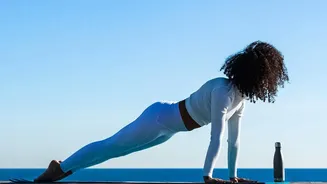
Plank Pose (Phalakasana)
The Plank is a foundational pose for a reason: it engages your entire core from front to back. It strengthens your abdominal muscles, shoulders, and glutes while teaching the body to maintain a stable, straight line, which is crucial for good posture. To practice, start on your hands and knees, then step your feet back until your body forms a straight line from head to heels. Ensure your wrists are under your shoulders and actively press the ground away. Engage your core by drawing your belly button towards your spine, and squeeze your glutes to prevent your hips from dropping. Hold for 20-30 seconds, focusing on steady breathing. For a gentler modification, you can bring your knees to the mat.
Boat Pose (Navasana)
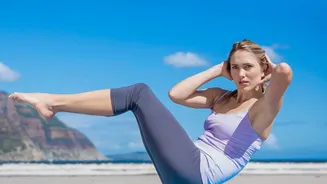
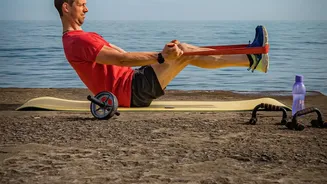
Boat Pose is a potent exercise for targeting the deep abdominal muscles and hip flexors. It challenges your balance, forcing your core to work hard to keep you steady. To begin, sit on the floor with your knees bent and feet flat. Lean back slightly, keeping your spine straight, and lift your feet off the floor. Start by keeping your shins parallel to the ground. For a gentler version, you can keep your knees bent and even hold onto the backs of your thighs for support. As you get stronger, you can work towards straightening your legs. The key is to keep your chest lifted and avoid rounding your back. Hold for 5 deep breaths, feeling the core muscles fire up to maintain stability.
Bridge Pose (Setu Bandhasana)
While often seen as a backbend, Bridge Pose is also a fantastic core strengthener, particularly for the posterior chain—the glutes and lower back, which are essential parts of your core. Lie on your back with your knees bent, feet flat on the floor hip-width apart, and arms by your sides. Press into your feet and lift your hips off the floor, engaging your glutes and hamstrings. Try to create a straight line from your shoulders to your knees. Hold this position, continuing to press your hips upward and engaging your core to keep your lower back supported. This pose not only strengthens but also provides a gentle stretch for the front of the body. Hold for 30 seconds before slowly lowering back down.
Bird-Dog Pose (Dandayamana Bharmanasana)
This pose is excellent for beginners as it builds stability and teaches the core to resist rotational forces, which is vital for protecting the spine. Start on your hands and knees in a tabletop position, with a flat back. Engage your abdomen by pulling it inward. Slowly extend your right arm forward and your left leg straight back, maintaining your balance. The goal is to keep your hips and shoulders level, preventing your torso from twisting. Hold for a few seconds, focusing on length from your fingertips to your heel, then gently return to the starting position and switch sides. This controlled movement enhances coordination and strengthens the deep muscles that support your spine.