





A Groundbreaking Discovery
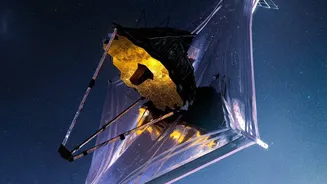
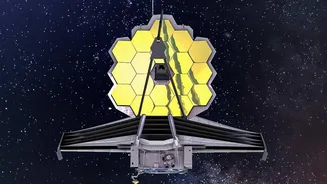
In a series of stunning observations, the James Webb Space Telescope has confirmed the presence of water vapour in the atmospheres of remote exoplanets classified as 'super-Earths'. This isn't just a faint hint; it's a clear chemical signature detected
across light-years of space. While water has been detected on giant gas planets before, finding it on smaller, potentially rocky worlds is a landmark moment in astronomy. It marks a pivotal shift from merely cataloguing planets to actively characterising them, moving us one step closer to answering the ultimate question: are we alone?
What Exactly Is a Super-Earth?
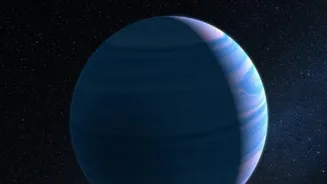
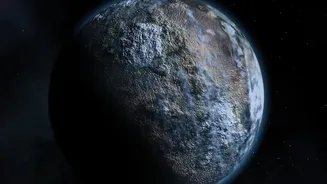
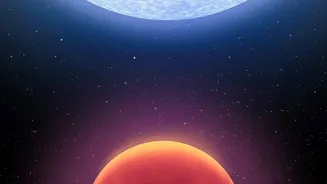
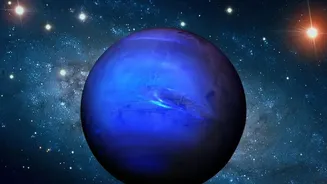
The term 'super-Earth' might conjure images of a bigger, better version of our own planet, but the reality is more complex and mysterious. A super-Earth is defined primarily by its mass and size—larger than Earth, but smaller than icy giants like Neptune. These planets are a common type in our galaxy, yet intriguingly, there are no examples in our own solar system. They can be rocky, gaseous, or a combination of both, with some potentially being scorching 'lava worlds' and others frigid 'snowball worlds'. This discovery of water vapour on such a planet adds another fascinating layer, suggesting some could be humid 'steam worlds'.
How to 'Smell' a Planet's Air From Light-Years Away
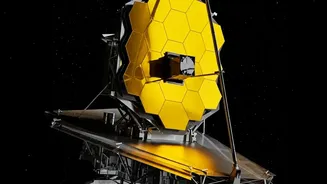
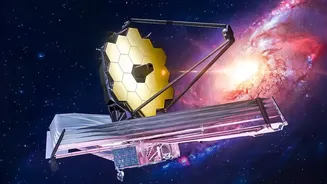
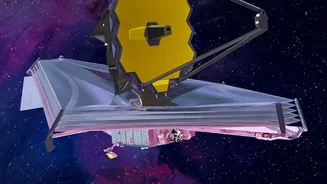
The technology behind this discovery is a technique called infrared transmission spectroscopy. Think of it this way: when an exoplanet passes in front of its host star from our viewpoint, a tiny fraction of the starlight filters through the planet's atmosphere. The James Webb Space Telescope's incredibly sensitive instruments, like its Near-Infrared Spectrograph (NIRSpec), can capture this light. Different chemical molecules in the atmosphere absorb specific colours, or wavelengths, of this light. Water vapour, for example, leaves a unique and identifiable 'fingerprint' in the light's spectrum. By analysing which colours are missing, scientists can determine what gases are present in that distant world's air.
Water, But Not Necessarily Life
Finding water vapour is a monumental achievement, as water is a key ingredient for life as we know it. However, scientists are quick to manage expectations. The presence of water vapour is not direct proof of life, nor does it confirm the existence of liquid water oceans. Some of the planets where water has been detected, like GJ 9827d, are extremely hot, with temperatures around 430 degrees Celsius, making them steamy but inhospitable. In some cases, there's even a debate about whether the water signature is from the planet's atmosphere or from cool spots on the star itself. Distinguishing between these possibilities is the next major challenge for researchers.
The Search Continues
This discovery is not an endpoint but a thrilling new beginning. It proves that the JWST has the capability to probe the atmospheres of smaller, Earth-sized and super-Earth-sized planets—a feat that was previously beyond our reach. The focus now will be on refining these techniques and searching for a whole suite of molecules. Future observations will look for biosignatures—gases like methane and oxygen in specific ratios that could strongly indicate the presence of biological processes. Each new detection, each atmospheric spectrum analysed, brings us closer to understanding the diversity of planets in our galaxy and identifying worlds that might have the right conditions for life to arise.