



The Universe We Thought We Knew
For decades, cosmologists have operated with a highly successful instruction manual for the universe called the Lambda-Cold Dark Matter (ΛCDM) model. It’s the standard model of cosmology, and it has been remarkably good at explaining a wide range of observations,
from the faint afterglow of the Big Bang to the large-scale structure of galaxies. The story goes like this: after the Big Bang, tiny fluctuations in density allowed cold, slow-moving dark matter to clump together, forming gravitational seeds. Over billions of years, these seeds grew into massive halos that pulled in ordinary matter, which then formed the stars and galaxies we see today in a bottom-up process, with small structures merging to create larger ones. This model suggests the universe is composed of about 5% normal matter, 27% dark matter, and 68% dark energy.
A New Eye on the Cosmos
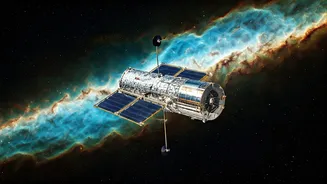
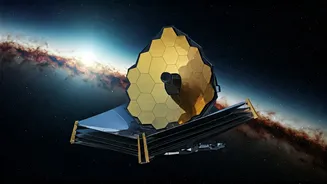
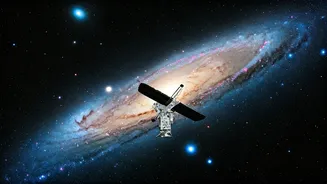
Enter the James Webb Space Telescope. Launched in 2021, its unparalleled power lies in its ability to peer into the infrared spectrum. Because the universe is expanding, light from the most distant objects gets stretched to longer, redder wavelengths as it travels across billions of years to reach us. This makes JWST a time machine, capable of seeing galaxies as they were in their infancy, just a few hundred million years after the Big Bang—a period previously hidden from view. Scientists expected to find small, disorganized, baby galaxies, consistent with the slow-and-steady growth predicted by the ΛCDM model. What they found was something else entirely.
Galaxies That Shouldn't Exist
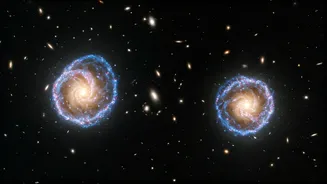
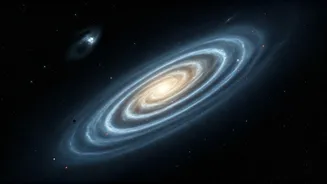
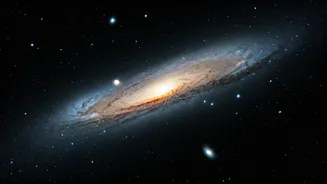
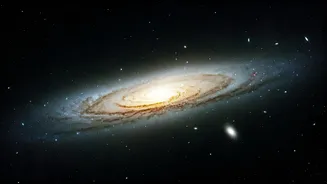
Almost immediately, JWST started spotting them: galaxies in the early universe that were far bigger, brighter, and more mature than they had any right to be. Some appeared to be fully formed, with distinct structures, at a time when theory predicted only chaotic, small-scale formations should exist. These ancient galaxies appeared to have formed stars at a furious rate, creating massive structures much earlier than the ΛCDM model would easily allow. It was like finding a fully grown adult in a nursery. This discovery of unexpectedly massive and evolved early galaxies has presented a major puzzle, forcing astronomers to question if their assumptions about star formation, galaxy growth, or even the underlying cosmological model are correct.
Cracks in the Standard Model?
These 'impossible' galaxies are not the only issue. JWST's observations have also intensified a long-running debate known as the "Hubble Tension." This is a persistent disagreement between two primary methods of measuring the universe's expansion rate. Measurements of the early universe, via the cosmic microwave background, predict one value (about 67 km/s/Mpc). But measurements of the local, modern universe using objects like pulsating stars give a faster value (around 73 km/s/Mpc). Scientists hoped JWST's precise instruments would resolve this discrepancy. Instead, its data has confirmed the measurements of the local universe, deepening the tension and suggesting that our standard model, which connects the early and late universe, might be missing a key ingredient.
A Crisis or an Opportunity?
So, has JWST broken cosmology? The short answer is no, but it has ushered in a period of thrilling uncertainty. Rather than killing the standard model, the telescope's findings are forcing scientists to refine their understanding of astrophysics. Perhaps star formation was far more efficient in the early universe, or early supermassive black holes acted as cosmic accelerators, jump-starting galaxy growth in ways we hadn't modeled. While some initial claims of 'paradigm-breaking' discoveries have been tempered as data is re-analyzed, the core puzzles remain. This isn't a failure of science; it's the process working exactly as it should. JWST was built to push boundaries and reveal the unexpected.