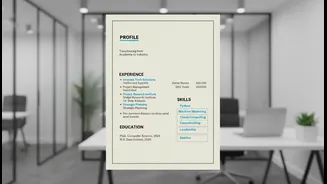









From Comprehensive Record to Marketing Tool
The single most critical shift is understanding the document’s purpose. An academic Curriculum Vitae (CV) is a comprehensive record of your scholarly life, often running many pages long. It's designed to prove your expertise to other academics through
exhaustive lists of publications, conferences, and research projects. In contrast, an industry resume is a one-to-two-page marketing document. Its sole purpose is to show a recruiter, who may spend only seconds scanning it, how your specific skills solve their company's problems. The evidence supports radical brevity and sharp focus; every line must earn its place by aligning with the specific job you’re applying for.
Supported: Cut Ruthlessly and Tailor Aggressively
Evidence and expert advice strongly support removing entire sections that are central to an academic CV. Long lists of publications, presentations, and attended conferences are largely irrelevant to industry hiring managers. While some top-tier firms recruiting PhDs may accept longer CVs, the safer and more effective strategy is a concise business resume. Instead of a full publication list, experts suggest a single bullet point summarizing your publication record if necessary. The goal is to create multiple versions of your resume, each tailored to the keywords and required skills found in a specific job description. This shows you've done your homework and understand the business's needs, rather than expecting them to decipher your academic history.
Unsupported: Simply Listing Your Duties and Research Topics
A common mistake is describing academic work without framing its impact. Listing a research topic or stating you “conducted experiments” is not compelling. Industry recruiters care less about the topic itself and more about the results you generated and the skills you used. The evidence supports translating duties into quantifiable achievements. For example, instead of just mentioning teaching, describe it as developing and delivering technical training to groups and achieving positive feedback. Grant writing can be framed as persuasive communication and securing funding. One popular, evidence-backed formula is X-Y-Z: “Accomplished [X] as measured by [Y] by doing [Z].” This shifts the focus from your responsibilities to your tangible impact.
Supported: Translating Jargon and Highlighting Transferable Skills
Your resume must be accessible to a non-specialist. Technical jargon that is standard in your field can be a major barrier for a recruiter or hiring manager. The key is to translate, not to “dumb down.” Instead of detailing a complex methodology, explain the outcome in plain language. Focus on transferable skills that are highly valued in business: project management, data analysis, problem-solving, budget management, and team collaboration. Your research experience is your work experience; frame it as such. Managing a research project involved deadlines, resource allocation, and stakeholder communication—all hallmarks of project management.
Unsupported: Believing Your Technical Skills Are Enough
While technical expertise is what gets you considered, evidence suggests it’s not what gets you hired. Recruiters often look for so-called “soft skills” like communication, leadership, and teamwork. There is a persistent bias that academics can be brilliant loners, so your resume must actively combat this. Highlight experiences where you mentored students, collaborated with other labs, organised events, or led a student group. Quantify this leadership where possible, noting the size of the team, the budget you managed, or the number of attendees at an event you planned. These details provide concrete proof that you can thrive in a collaborative corporate environment.