






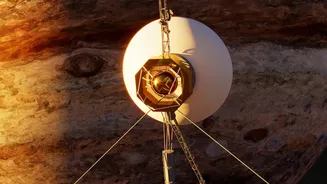

A Peculiar Red Asteroid
In the vast expanse of the main asteroid belt between Mars and Jupiter lies 269 Justitia, an object that has baffled scientists. Discovered in 1887, it wasn't until recently that its strange nature became clear. Justitia is exceptionally red, a colour
rarely seen in the asteroid belt. This reddish hue is believed to come from complex organic compounds called tholins, which form when cosmic radiation interacts with simple ices like methane. Such materials are common in the far reaches of our solar system, out beyond Neptune, but are highly unusual closer to the sun. This has led scientists to theorise that Justitia is not native to its current location but is a migrant, a relic from the outer solar system that was pulled inwards during the chaotic early days of planetary formation.
NASA's Ambitious Grand Tour
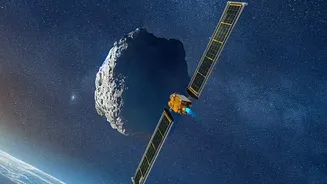
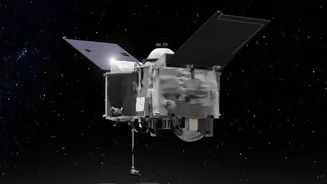
Unraveling the mystery of Justitia is a key goal for NASA's Lucy mission. Launched in 2021, Lucy is on a record-breaking 12-year journey to visit a diverse collection of asteroids, primarily the Jupiter Trojans, which are ancient 'fossils' from the birth of the solar system. While not the final object Lucy will visit, Justitia was added to the probe's itinerary as a crucial target of interest. The flyby will allow scientists to study its surface composition up close, potentially confirming its origins in the distant Kuiper Belt. Getting a detailed look at this cosmic traveller will provide invaluable clues about how our solar system was built and how the building blocks of life, which include complex organic materials, may have been distributed.
A New Era for Indian Space Innovation
While the Lucy probe is a NASA-led endeavour, the mission's focus on cutting-edge exploration highlights a new and exciting frontier for India. The headline's mention of 'HEX20', while not a widely known entity in this specific mission, is representative of a powerful new wave in the nation's space ambitions: the private startup. Since the sector was opened to private participation in 2020, India has seen an explosion of space-tech companies. By 2026, the country was home to around 400 such startups, working on everything from launch vehicles to satellite constellations and advanced propulsion systems. This burgeoning ecosystem is transforming India from a nation reliant on its esteemed government agency, ISRO, to a multi-faceted space power with a dynamic commercial engine.
The Path to Deep Space Collaboration
For an Indian startup to contribute to a future deep-space mission like Lucy, it requires demonstrating world-class reliability and innovation. Companies like Skyroot Aerospace, which has successfully launched its own orbital rocket, and Agnikul Cosmos, with its 3D-printed engines, are proving that Indian firms can compete globally. Others, like Bellatrix Aerospace, specialize in the kind of high-precision components, such as satellite propulsion systems, that are critical for interplanetary probes. Getting involved in international missions often means partnering with agencies like NASA, a process that involves rigorous vetting and certification. As Indian startups build their track record and develop unique technologies, the prospect of seeing 'Made in India' components on probes exploring asteroids and planets grows ever closer.
Why This Matters for India
The story of 269 Justitia and the technology needed to reach it is not just about space; it is about India's economic future. The government projects that India's share of the global space economy could grow from around $9 billion to over $40 billion in the next decade. This growth will be driven by private innovation. Every successful launch by a company like Skyroot, every new patent filed by a startup like GalaxEye, and every investment in firms like Pixxel builds momentum. This creates high-tech jobs, inspires students to pursue science and engineering, and strengthens India's strategic autonomy. By aiming for the stars, Indian startups are not just building rockets and satellites; they are helping to build a new pillar of the national economy.