


More Than Just a 'Failed Star'
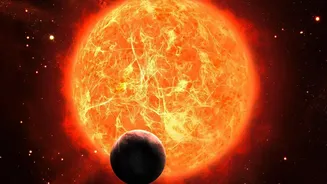
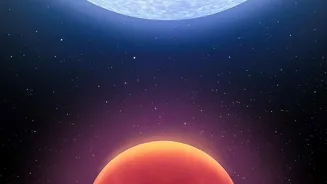
Often called 'failed stars', brown dwarfs are celestial bodies that are not quite stars and not quite planets. They occupy a fascinating middle ground, with masses ranging from about 13 to 80 times that of Jupiter. This size is significant because it dictates
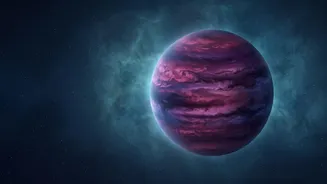
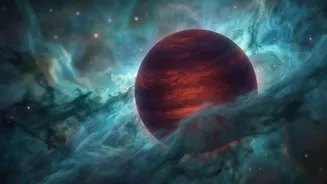
their destiny. While they are born from the same collapsing clouds of gas and dust that create stars, they never accumulate enough mass for their cores to become hot and dense enough to ignite and sustain the nuclear fusion of hydrogen, the process that makes stars shine brightly for billions of years. However, the most massive brown dwarfs are hot enough to briefly fuse a heavier type of hydrogen called deuterium in their youth. This temporary spark sets them apart from gas giant planets like Jupiter, but their inability to burn regular hydrogen for the long haul prevents them from joining the ranks of true stars. They are not actually brown; depending on their temperature, they glow dimly in shades from deep red to magenta, mostly emitting heat in the infrared spectrum.
A Tale of Two Births
One of the most important lessons from brown dwarfs concerns formation. Their very existence demonstrates that the universe has more than one way to build its contents. Stars and brown dwarfs share a common origin story: the gravitational collapse of a huge, dense cloud of interstellar gas. Pockets within these clouds contract under their own weight, heating up to form a protostar. If it gathers enough material, a star is born. If it stops short, it becomes a brown dwarf. Planets, on the other hand, are typically built from the ground up. They form through accretion within a rotating disk of leftover gas and dust that surrounds a newborn star. A small rocky or icy core forms first, and then it gradually pulls in gas to grow into a giant like Jupiter. By studying brown dwarfs, some of which are ejected from their stellar nurseries before they can grow, scientists can better understand the minimum mass required to form a star through gravitational collapse, a process that is still not fully understood.
Cosmic Weather Laboratories
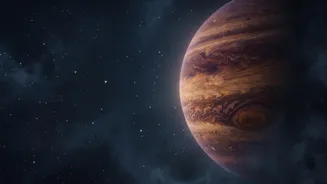
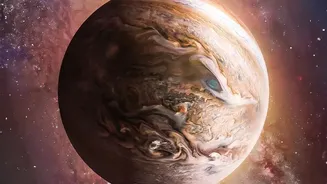
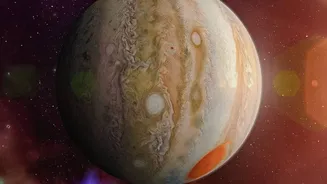
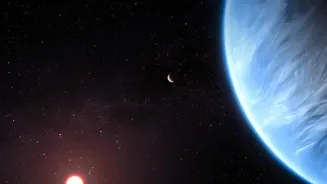
Because many brown dwarfs drift through space alone, they offer a unique advantage over exoplanets: they can be studied in detail without the blinding glare of a host star. This makes them perfect laboratories for understanding planetary atmospheres. Observations have revealed that brown dwarfs have surprisingly complex, planet-like weather. Scientists have detected vast cloud systems, not of water vapor, but of exotic materials like molten iron, hot sand, and salts. Brightness variations indicate turbulent, stormy conditions similar to the giant storms on Jupiter. Recent breakthroughs using the James Webb Space Telescope (JWST) have even confirmed the presence of water clouds on a nearby cold brown dwarf that change in thickness over time, providing the first direct evidence of weather patterns on a world outside our solar system. Studying these dynamic atmospheres helps scientists model the conditions on the gas giant exoplanets they are now discovering in abundance.
Pushing the Boundaries of Formation
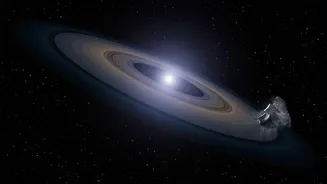
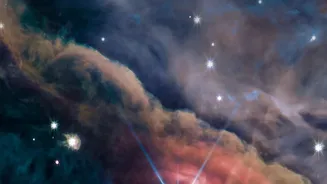
The study of brown dwarfs continues to deliver surprises that challenge our neatest theories. Using the unprecedented sensitivity of the JWST, astronomers have recently discovered free-floating brown dwarfs with masses as low as just two to four times that of Jupiter. These objects, found in the star-forming region IC 348, are far smaller than models predicted was possible for an object forming via cloud collapse. This discovery blurs the line between the smallest brown dwarfs and the largest 'rogue' planets that may have been ejected from their own solar systems. In an even more stunning twist, astronomers found that one of these tiny brown dwarfs appears to have a disk of material orbiting it, suggesting that planets could potentially form around an object that is itself the size of a giant planet. These findings force scientists to reconsider the full variety of objects that can be produced during the chaotic process of star birth.