
Long hours at a desk, behind the wheel, or on the couch can leave your hips feeling tight and your glutes inactive. This can lead to discomfort in your lower back and limit your movement. Here are five simple stretches to counteract the effects of sitting.
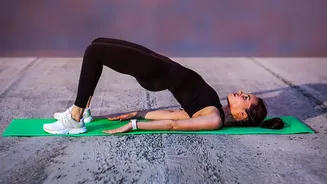
1. Glute Bridge
This exercise is fundamental for 'waking up' gluteal muscles that have become inactive from prolonged sitting. By strengthening the glutes, you provide better support for your lower back and hips. To perform a glute bridge, lie on your back with your knees bent, feet flat on the floor about hip-width apart, and your arms by your sides. Press your heels into the floor, squeeze your glutes, and lift your hips until your body forms a straight line from your shoulders to your knees. It's important to drive the movement from your hips, not by arching your lower back. Hold the position for a few seconds before slowly lowering your hips back to the floor. Aim for 10 to 15 repetitions.
2. Seated Pigeon Pose
Also known as the figure-four stretch, this is a perfect and discreet stretch you can do while sitting in a chair. It primarily targets the piriformis, a small muscle deep in the buttocks that can become tight and contribute to hip discomfort. Sit on a chair with your feet flat on the floor. Cross your right ankle over your left thigh, just above the knee. Keep your right foot flexed to protect the knee joint. If you already feel a good stretch in your right hip and glute, hold this position. For a deeper stretch, maintain a straight back and gently lean forward from your hips until you feel an increased sensation. Hold for 20-30 seconds, breathing deeply, and then switch to the other side.
3. Kneeling Hip Flexor Stretch
Sitting shortens the muscles at the front of your hips, known as the hip flexors. This stretch helps to lengthen them, relieving tension and improving posture. Kneel on a soft surface. Step your right foot forward so your right knee is bent at a 90-degree angle, with your knee directly above your ankle. Your left knee should be on the floor directly under your hip. Place your hands on your right knee for support and keep your back straight. Gently tuck your pelvis and shift your weight forward into the right hip until you feel a stretch along the front of your left thigh. Avoid arching your lower back. Hold for 30 seconds before switching legs.
4. 90/90 Hip Rotations
This dynamic stretch is excellent for improving both the internal and external rotation of your hips, which is often restricted by a sedentary lifestyle. Sit on the floor and bend your knees. Position your legs so that your right shin is on the floor in front of you, parallel to your body, and your left shin is out to the side, also on the floor. Both knees should be at a 90-degree angle. Try to sit up as tall as possible, keeping your chest upright. You can place your hands on the floor for support. Hold for a moment, then smoothly rotate your legs to the other side, so your left shin is now in front. Continue alternating sides for 8-10 repetitions, focusing on controlled movement.
5. Cat_Cow Stretch
While this stretch mobilises the entire spine, it's invaluable for people who sit all day because it also encourages movement in the pelvis. It helps relieve tension in the back and neck and improves posture. Start on your hands and knees with your wrists under your shoulders and your knees under your hips. As you inhale (the 'cow' phase), let your belly drop towards the floor, lift your tailbone, and look forward, creating a gentle arch in your spine. As you exhale (the 'cat' phase), press into your hands, round your spine towards the ceiling, and tuck your chin to your chest. Flow between these two positions for 5–10 full breaths, coordinating the movement with your breathing.