



The Orbital Junkyard
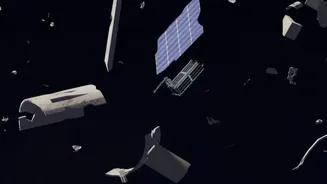
Low Earth Orbit (LEO), the region of space up to 2,000 kilometres in altitude, is home to thousands of active satellites vital for communication, navigation, and science. It is also cluttered with an enormous amount of space junk. The European Space Agency
(ESA) estimates there are over 1.2 million pieces of debris larger than 1 cm orbiting Earth. This includes everything from defunct satellites and spent rocket stages to tiny fragments from past collisions. Travelling at speeds approaching 8 kilometres per second, even a paint fleck can cause catastrophic damage to an operational satellite or crewed spacecraft. This growing threat has spurred what is known as the Kessler Syndrome, a theoretical cascade where collisions create more debris, leading to more collisions, potentially rendering parts of orbit unusable.
The Capture Missions: Nets and Harpoons
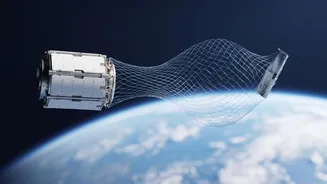
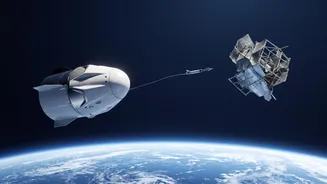
Some of the most intuitive solutions involve physically capturing debris. The RemoveDEBRIS mission, led by the University of Surrey and co-funded by the European Union, successfully tested both a net and a harpoon in orbit. The net experiment involved deploying a net to capture a target, demonstrating a way to bag uncooperative, tumbling objects. The harpoon was fired at a target panel, piercing it to show how a chaser satellite could securely spear a piece of junk. These technologies are designed for larger, known pieces of debris. Companies like Japan's Astroscale are building on these concepts, developing services to capture and de-orbit multiple pieces of debris in a single mission. Astroscale's ELSA-d mission successfully tested a magnetic docking system, and its upcoming ELSA-M mission aims to remove a OneWeb satellite in 2026.
The Robotic Approach: Claws and Arms
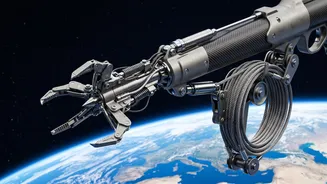
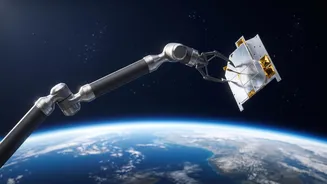
Another prominent method for active debris removal is the use of robotic arms. The Swiss startup ClearSpace, commissioned by ESA, is developing the ClearSpace-1 mission to remove a piece of a Vega rocket adapter left in orbit. Originally slated for a 2026 launch, the mission is now targeting a 2028 launch to capture the PROBA-1 satellite. The spacecraft is designed like a "space claw," with four robotic arms that will grab the target, secure it, and then steer the combined stack into Earth's atmosphere to burn up on reentry. This approach is ideal for capturing known objects that were not designed to be serviced or grappled. The mission represents a significant step from demonstration to an operational cleanup service.
The Sci-Fi Solution: Lasers
Perhaps the most futuristic concept is the use of lasers. The idea isn't to blast debris into smithereens, which would only create more junk. Instead, a powerful ground-based or space-based laser would target a piece of debris, heating one side of it. This process, called laser ablation, vaporizes a tiny amount of the object's surface, creating a small amount of thrust that acts like a micro-engine. This gentle but persistent nudge is enough to alter the object's trajectory, slowing it down so that its orbit decays and it eventually re-enters and burns up in the atmosphere. This method is seen as particularly promising for dealing with the thousands of smaller, more difficult-to-capture debris objects measuring between 1 and 10 centimetres.
The Business of a Cleaner Orbit
Cleaning up space is no longer just a theoretical problem; it's an emerging commercial market. The growth of satellite mega-constellations has heightened awareness and created a business case for debris removal. Companies like Astroscale, ClearSpace, and others are pioneering what they hope will become routine "in-orbit servicing." This includes not only debris removal but also satellite life extension and inspection. Governments are also getting involved. The U.S. passed the ORBITS Act to fund demonstration programs, and the UK and European space agencies are funding missions with private partners. These initiatives are turning space sustainability from a guideline into an active, and potentially lucrative, industry.