




What Are These Cosmic Lighthouses?
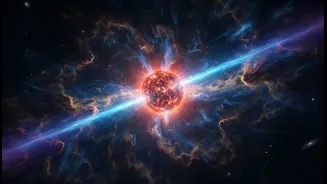
At their core, pulsars are a type of neutron star, which are the incredibly dense remnants left behind after a massive star collapses. Think of an object with more mass than our Sun, crushed into a sphere just 20 kilometres across. This extreme density
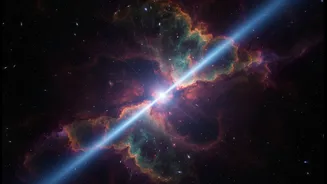
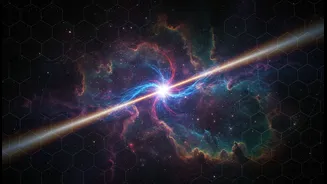
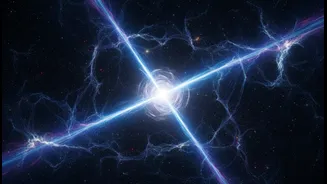
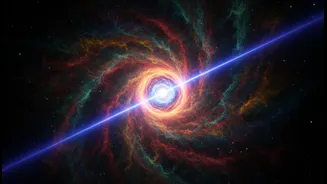
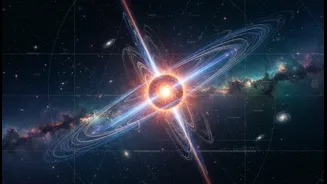
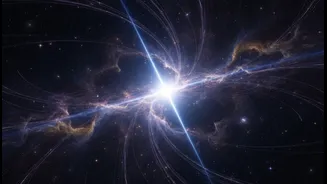
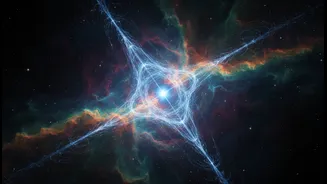
leads to some wild physics. What makes a pulsar a 'pulsar' is its rapid spin and powerful magnetic field. This combination causes it to emit powerful beams of radiation from its magnetic poles. Because the star is spinning, these beams sweep across the cosmos like the rotating lamp of a lighthouse. From our perspective on Earth, if we're in the path of that beam, we detect a regular 'pulse' of radiation, which is how these objects got their name.
From Anomaly to Navigational Chart
When the first pulsar was discovered in 1967 by Jocelyn Bell Burnell, the regularity of its signal was so strange that it was humorously nicknamed LGM-1 for 'Little Green Men'. Scientists quickly realised its natural origin, and since then, thousands have been catalogued. Recently, NASA has taken this a step further. By using instruments like the Neutron star Interior Composition Explorer (NICER) aboard the International Space Station, scientists can time the arrival of pulsar signals with atomic-clock precision. This has led to the creation of detailed pulsar maps. Just last year, NASA's Imaging X-ray Polarimetry Explorer (IXPE) spent nearly 18 days mapping the magnetic field of the 'Lighthouse Nebula' and its central pulsar, confirming theories about how these structures are formed.
A GPS for the Galaxy
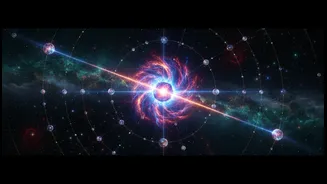
This precise mapping isn't just for academic curiosity; it has profound practical applications. The predictable timing of pulsars makes them ideal navigation beacons for deep space. A spacecraft can determine its location by triangulating its position from several known pulsars, much like how GPS uses satellites orbiting Earth. This technology, called XNAV (X-ray pulsar-based navigation and timing), was successfully demonstrated by NASA's SEXTANT experiment. For future missions to Mars and beyond, where communicating with Earth can take hours, having an autonomous, onboard navigation system is a game-changer, removing the reliance on the Deep Space Network on Earth.
The Universe's Ultimate Particle Accelerators
Pulsars are also natural laboratories for studying physics at energies far beyond what we can create on Earth. The combination of an incredibly strong magnetic field and rapid rotation creates enormous electric fields. These fields grab charged particles, like electrons, from the star's surface and accelerate them to nearly the speed of light. This process turns the area around a pulsar into the most efficient particle accelerator known in the universe, far more powerful than the Large Hadron Collider. The beams we detect are the radiation given off by these super-charged particles as they spiral along magnetic field lines. Studying this radiation gives scientists invaluable insight into the behaviour of matter under the most extreme conditions imaginable.
Decoding the High-Energy Universe
When these accelerated particles, forming what's called a 'pulsar wind', slam into surrounding gas and dust, they create a 'pulsar wind nebula'. This is where some of the most energetic phenomena occur. The accelerated particles can collide with lower-energy photons, transferring their energy and boosting the photons into extremely high-energy gamma rays through a process called inverse Compton scattering. Recent observations of pulsars like the one in the Vela constellation have detected photons with energies trillions of times higher than visible light. By mapping these energetic zones and understanding the magnetic fields that shape them, as IXPE is now doing, scientists can finally begin to piece together the puzzle of where the universe's highest-energy cosmic rays originate.