





The Martian Air Problem
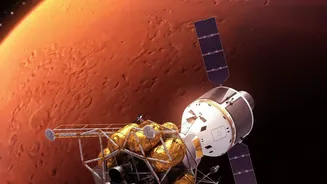
Future astronauts on Mars cannot simply take off their helmets. The Red Planet's atmosphere is extremely thin and composed of about 96% carbon dioxide (CO2), with only a tiny fraction of oxygen. For humans to survive, let alone establish a long-term presence,
they need a reliable way to generate large quantities of breathable air. This concept of using local materials is known as In-Situ Resource Utilization (ISRU), and it's seen as a cornerstone of sustainable space exploration. Instead of launching heavy, expensive oxygen tanks from Earth, ISRU proposes we 'live off the land' by converting the abundant CO2 into life-sustaining O2.
From a Toaster-Sized Proof to a Full-Scale Factory
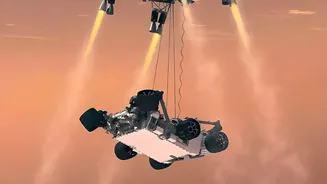
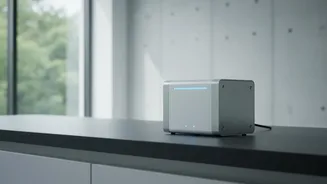
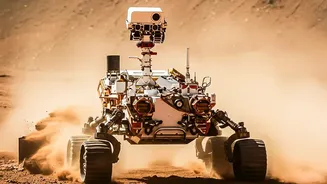
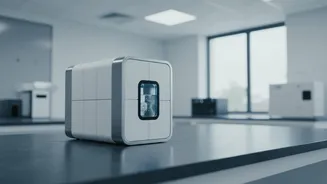
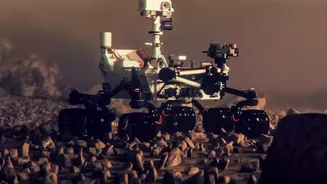
The first major breakthrough came from a device aboard NASA's Perseverance rover called MOXIE (Mars Oxygen In-Situ Resource Utilization Experiment). This toaster-sized instrument successfully and repeatedly proved that oxygen could be produced on Mars by pulling in the Martian air, heating it to around 800°C, and using an electrochemical process to split the CO2 molecules. Between 2021 and 2023, MOXIE completed 16 runs, producing about 122 grams of oxygen in total. While a monumental achievement, this output is tiny—barely enough for an astronaut to breathe for a couple of hours. The real challenge, and the focus of current research, is scaling this technology up by several hundred times to support an entire human mission.
How Advanced Electrolysis Works
The technology at the heart of this process is the Solid Oxide Electrolysis (SOXE) stack. Think of it as a specialized fuel cell running in reverse. The Martian atmosphere is filtered, compressed, and heated before being fed into the reactor. Inside, a stack of ceramic cells made of materials like scandia-stabilized zirconia acts as an electrolyte. When an electric current is applied, the CO2 molecules break apart. Oxygen ions are selectively passed through the ceramic electrolyte to one side, where they recombine to form pure, breathable oxygen (O2). The waste product, carbon monoxide (CO), is vented away. Recent advancements have focused on making these stacks larger, more efficient, and more durable, with newer designs showing a 33-fold increase in scale compared to the original MOXIE device.
The Immense Scaling Challenge
Going from producing 12 grams of oxygen per hour—MOXIE's peak performance—to the 2-3 kilograms per hour needed for a human base is a massive engineering leap. A mission-scale system, capable of supporting astronauts, would likely weigh around a ton and require a significant power source, such as a dedicated 25-30 kilowatt plant. Researchers are developing larger electrolysis stacks with increased cell area and more cells per stack to boost production. They are also working on improving the system's robustness to withstand the harsh Martian environment, including extreme temperature swings and dust. The goal is to create a fully autonomous plant that can reliably churn out oxygen for months on end before astronauts even arrive.
More Than Just Breathing: Fuel for the Trip Home
While vital for life support, the vast majority of the oxygen produced on Mars would be for a different purpose: rocket propellant. Getting a crew of astronauts off the Martian surface for the return journey to Earth would require an estimated 25 metric tons of liquid oxygen to burn with fuel. Transporting this from Earth is not feasible. Therefore, a scaled-up oxygen factory is the critical component that makes a return trip possible. By producing both breathable air and the primary component of rocket oxidizer on-site, these advanced electrolysis reactors are not just a life support system; they are the key to unlocking a two-way ticket to Mars, making human exploration more practical and sustainable than ever before.