







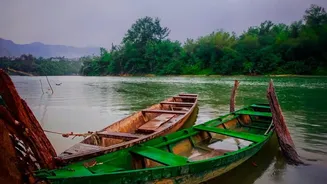

An Ancient Need for Speed
The story of the Chundan Vallam, or snake boat, begins not with sport, but with war. Legend holds that in the 14th century, a king of the Chempakassery kingdom, frustrated by losses in backwater conflicts, commissioned a new kind of war canoe. He needed
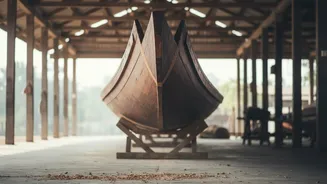
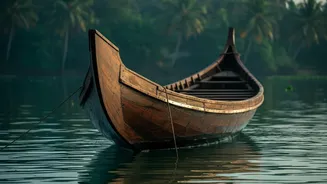
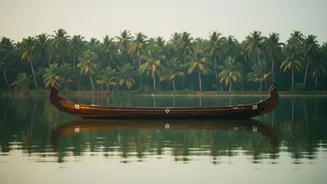
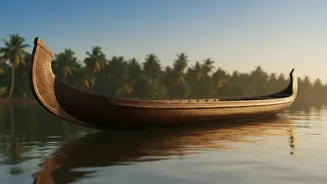
a vessel that was faster, more agile, and capable of carrying up to 100 warriors through narrow channels for surprise attacks. The result was a long, slender boat with a high, curved stern resembling a snake's raised hood. The design was so effective that it became a prized military asset. When the wars eventually ceased, these remarkable boats didn't vanish; they were reborn as the centrepiece of cultural and religious festivals, most notably the thrilling Vallam Kali, or boat races, that electrify the region today.
The Master Carpenter's Sacred Trust
At the heart of every snake boat is the master craftsman, the Moothashari. This role is more than just an engineer; it's a blend of artist, spiritual guardian, and community leader. Knowledge of snake boat construction is not found in textbooks or computer programs but is passed down orally through generations. These master builders, known as Asaris, rely on an intuitive understanding of hydrodynamics and inherited mathematical principles laid out in ancient texts like the Sthapatya Veda. A Moothashari determines the boat's every critical dimension—its length, the precise curvature of the hull, and the delicate balance between width and weight distribution. Even a fractional deviation can ruin a boat's stability and speed, making the Asari's experience and ancestral wisdom invaluable.
From Forest to Water: A Ritualistic Journey
The creation of a snake boat is steeped in ritual from the very first step. The process begins with selecting the right tree, often Anjili (wild jackfruit wood), prized for its flexibility and resistance to rot in water. This isn't merely a practical choice; it's a spiritual one, with the selection and felling of the tree performed on an auspicious day. The construction itself starts with a ceremony called 'Ulikuthal,' marking the first cut of the chisel into the wood. The entire village often participates, as the boat is not just a vessel but a representation of their collective pride and identity. As the hull takes shape, planks are joined with meticulous care, fastened with iron bolts and sealed with a traditional caulking mixture of coconut oil, cotton, and resin to make it waterproof. Every stage, from laying the keel to the final polishing with fish oil and egg whites for a slick finish, is a blend of precise engineering and deep-rooted custom.
The Geometry of Victory
The snake boat's design is a masterclass in fluid dynamics, achieved without modern instruments. The extremely narrow, long hull—often over 100 feet long but just a few feet wide—is designed to cut through the water with minimal drag, a concept modern science calls a high aspect ratio. The elevated stern, rising up to 20 feet, is not just for aesthetics. It acts as a crucial counterbalance; as a hundred rowers propel the boat forward, the prow tends to dip, but the weight of the high stern lifts the front, allowing the boat to glide on the water's surface rather than plow through it. The slight flex in the long hull, achieved through traditional joinery, allows the boat to absorb the stress of choppy water instead of cracking. This ancient understanding of buoyancy, balance, and drag reduction is what gives the Chundan Vallam its legendary speed.