




The People’s Science
Citizen science is a powerful concept where public volunteers participate in scientific research, from collecting data to analysing it. This approach has flourished globally, particularly in fields like astronomy and ecology, where the sheer volume of
data is too vast for professional scientists to handle alone. Enthusiasts, students, and amateur scientists can help monitor environmental changes, track species, or even discover new celestial objects. The primary benefit is strength in numbers, enabling data collection across huge geographical areas and over long periods, something that would otherwise be prohibitively expensive. Projects like these also foster a deeper public engagement with science, turning curiosity into tangible contributions.
Sikkim's Starry Success
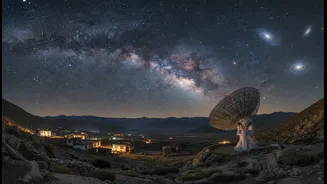
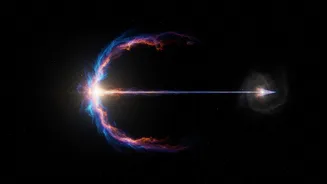
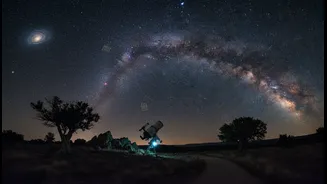
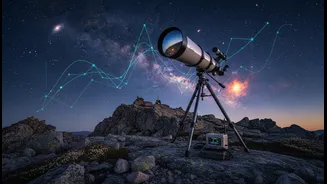
In India, the RAD@home Collaboratory is a prime example of citizen science in action. This platform, founded in 2013, trains volunteers to analyse radio telescope data from home. A remarkable success story emerged recently from a remote village in Sikkim, where a citizen scientist named Pranim Limbo made a significant discovery. While reviewing images from the Low-Frequency Array (LOFAR) telescope, Limbo identified a uniquely shaped radio galaxy, now dubbed the 'Bow-and-Arrow' galaxy (BAARG). This finding, later confirmed by a professional team and published in a prestigious journal, showcases the immense potential of citizen-led initiatives to make genuine scientific breakthroughs. It highlights how motivated individuals, regardless of their location, can contribute to the frontiers of astronomy.
The Challenge of Credibility
Despite such successes, the world of citizen science faces a significant hurdle: data quality. Critics rightly point out that without proper training and standardised methods, data collected by volunteers can be inconsistent, biased, or simply inaccurate. This scepticism in the academic world is not without reason; many projects struggle to produce scientifically valid results that can be published in peer-reviewed journals. Issues can range from misidentification of species in ecological studies to inconsistent measurements. Without a robust verification process, there's a risk of accumulating 'noise' rather than useful information, potentially undermining the very research the project aims to support. The challenge is to find the right balance between encouraging mass participation and ensuring the scientific rigour of the data collected.
Why Expert Validation is Key
The solution isn't to dismiss citizen science, but to integrate it more deeply with professional oversight. Expert validation is the critical step that bridges the gap between amateur observation and credible scientific data. This can take several forms: experts reviewing unusual findings flagged by volunteers, automated filters that flag data outliers for review, or requiring photographic evidence to accompany observations. The discovery in Sikkim is a perfect model; the initial spotting by a citizen scientist was followed by rigorous follow-up and analysis by professional astronomers. This collaborative workflow leverages the broad reach of volunteers to sift through massive datasets, while ensuring that the final conclusions are scientifically sound. This structured partnership turns a potential weakness into a powerful, hybrid research model.
Building a Collaborative Future
For citizen science in India to reach its full potential, from the Himalayas to the coasts, building strong frameworks for collaboration is essential. This means investing in training for participants, developing user-friendly platforms that guide data collection, and establishing clear channels for communication between amateurs and experts. Rather than viewing them as separate, projects should be designed from the ground up as partnerships. Researchers can actively participate on these platforms, helping to validate data and mentor enthusiasts, which in turn boosts engagement and data quality. Success stories like the discovery of BAARG prove that when the passion of the public is combined with the precision of professional science, the possibilities are limitless, advancing not just research but also scientific literacy across the nation.